Trade show press release template: the four releases of an edition, embargoes and the press kit
A trade show press release template to copy, the four releases every edition needs, how embargoes work, and what goes in the exhibition press kit.
By Moultaka team
A trade show press release is one page with one piece of news: the show opens, the conference programme is out, a minister will cut the ribbon, the edition closed with these results. The who, what, where, when and why-it-matters sit in the first five lines; a quote from the organiser, the practical details and a press contact who answers the phone follow. The press kit is the longer companion document a journalist keeps for the whole show. Below you will find an event press release template to copy, an example of when to send each release, and a checklist for the exhibition press kit.
Four press releases per edition
An edition is told in four releases, each with its own news. None of them simply repeats the dates.
| When | The news | What goes with it |
|---|---|---|
| About three months out | The show is announced: dates, venue, theme, first exhibitors | A link to the online newsroom |
| One month out | The conference programme, the countries and sectors taking part | The press accreditation link |
| The day before, or the morning of, the opening | The opening, the official ceremony, what visitors will see | The press kit, under embargo if needed |
| Closing night, or within the week | The results: attendance, highlights, next edition’s dates | Photos of the edition, cleared for use |
These four slots belong in your wider event marketing plan, next to the visitor invitations and the exhibitor emails.
A trade show press release template
Copy it, fill in the brackets, and delete anything you cannot stand behind.
PRESS RELEASE · [City], [date] For immediate release (or: Embargoed until [day], [time] [time zone])
[Show name] opens [dates] at [venue]
The [nth] edition of [show name], the trade show for [sector], takes place from [date] to [date] at [venue]. Organised by [organiser], it brings together [number] exhibitors from [countries] around [this year’s theme].
New this year: [a national pavilion, a conference track, pre-scheduled B2B meetings, a sector joining for the first time].
“[One sentence from the organiser on why this edition matters, no superlatives],” said [first name last name], [title] at [organiser].
Practical information Dates and opening hours: [from … to …, … am to … pm] Venue: [hall, address] Admission: [online registration, free for trade visitors…] Visitor registration: [link]
Media contact [Name], [phone], [email] Newsroom, photos and press kit: [link]
About [organiser]: [two lines: who you are, since when, which shows].
Three habits keep it readable. The headline is the news, not your company name. The first paragraph stands on its own, because many editors read nothing else. Every figure is one you can back up: exhibitors signed, not footfall hoped for.
How a press release embargo works
An embargoed release reaches journalists early, with a date and time before which nothing may be published. It gives them time to write a proper piece, and gives you a single moment when the news breaks everywhere at once.
At a trade show, two moments justify one:
- the official opening, when the minister or dignitary inaugurating the show is confirmed late: the release goes out the evening before, embargoed until the ceremony (see our guide to VIP protocol and official delegations);
- the results, when attendance figures are only final on the last evening and should land in every outlet at the same time.
An embargo is a courtesy, not a contract. Use it only with reporters you already work with, put the date, time and time zone in bold at the very top, and keep it for news that deserves it.
What goes in an exhibition press kit
The release announces; the press kit explains. A reporter covering your show should be able to write the story without calling you.
- A message from the organiser, half a page, signed.
- A fact sheet: edition, dates, venue, sectors, expected audience, organiser.
- This edition’s figures, the ones you publish yourself, with last year’s for comparison.
- The programme of talks and highlights, with speakers.
- Exhibitors and countries, or at least the newcomers.
- Practical details: access map, hours, accreditation, on-site press room.
- Photos and logos in high resolution, cleared for use, captioned.
- Media contacts, with one person reachable throughout the show.
| Press release | Press kit | |
|---|---|---|
| Length | One page | Eight to twenty pages |
| Scope | One piece of news | The whole show |
| Timing | Every time there is news | Updated once per edition, handed out at the opening |
| Where | Emailed, then posted in the newsroom | A PDF download in the newsroom |
Writing for international and regional press
A show that draws exhibitors from several countries is covered by trade magazines abroad as well as national and local press at home. Write a version for each audience rather than one release for everyone: a trade title wants sector news and exhibitor names, a business daily wants the economic story, a local radio station wants dates and a voice. In the Gulf and North Africa, plan an Arabic release written as such, not translated the night before; it is often the version national media pick up.
Mistakes that send a release straight to the bin
- No news. A release that restates the previous one’s dates will not be read.
- A heavy attachment instead of text. Put the release in the body of the email and link the press kit.
- No reachable contact. The reporter who wants an interview at 6 pm needs a number that answers.
- Unusable photos: too small, uncaptioned or without usage rights.
- The same email to the whole list. A business reporter and a healthcare editor are not after the same angle.
- No tracking afterwards. Without a list of what was published, you have nothing to show sponsors (see the post-show report).
In short
- A trade show press release is one page, one piece of news, the essentials in the first five lines.
- An edition is told in four releases: announcement, programme, opening, results.
- Embargoes are for the opening ceremony and the results, with trusted reporters only.
- The press kit covers the whole show and is downloaded from the newsroom.
- Each audience, and each language, gets its own version.
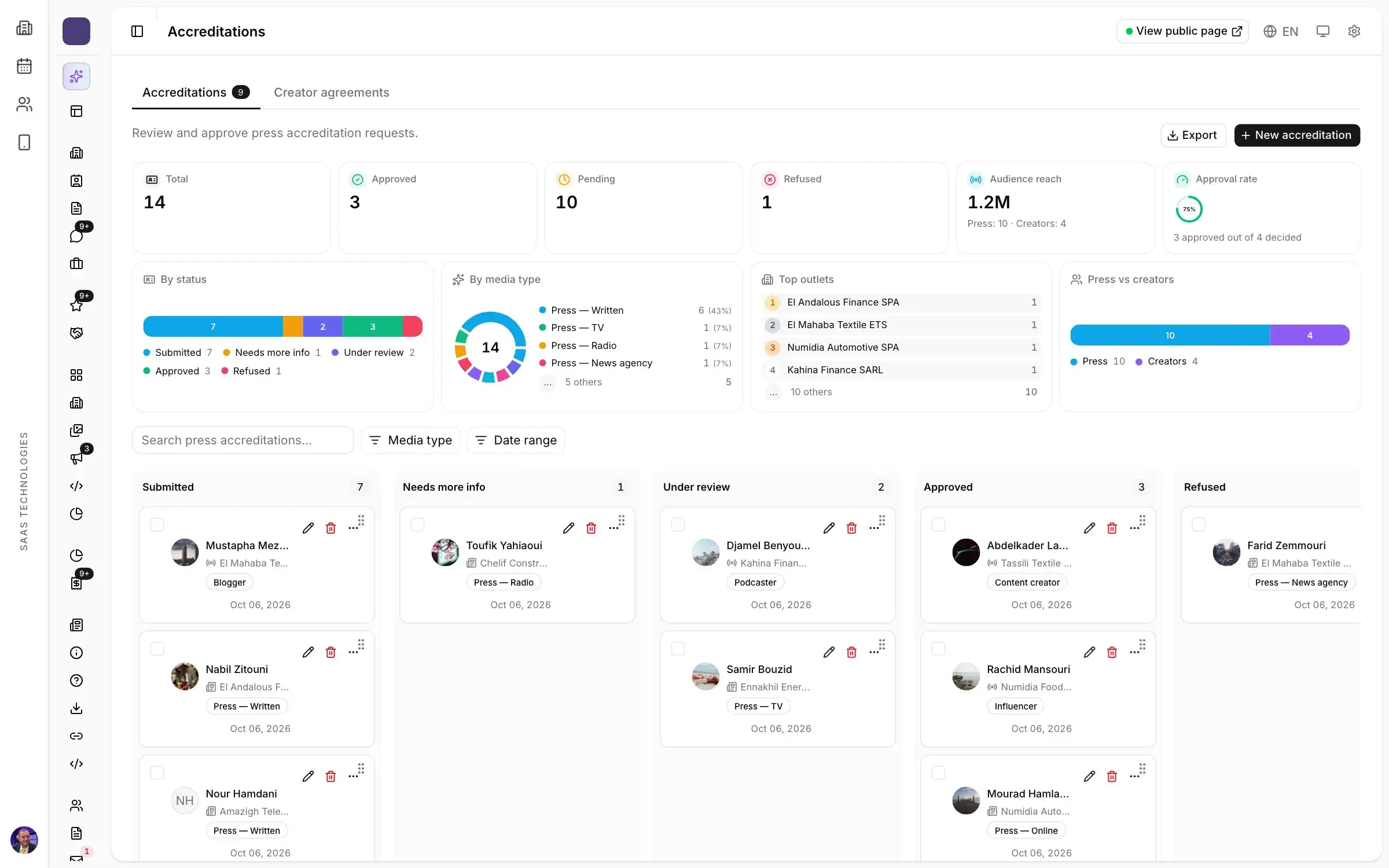
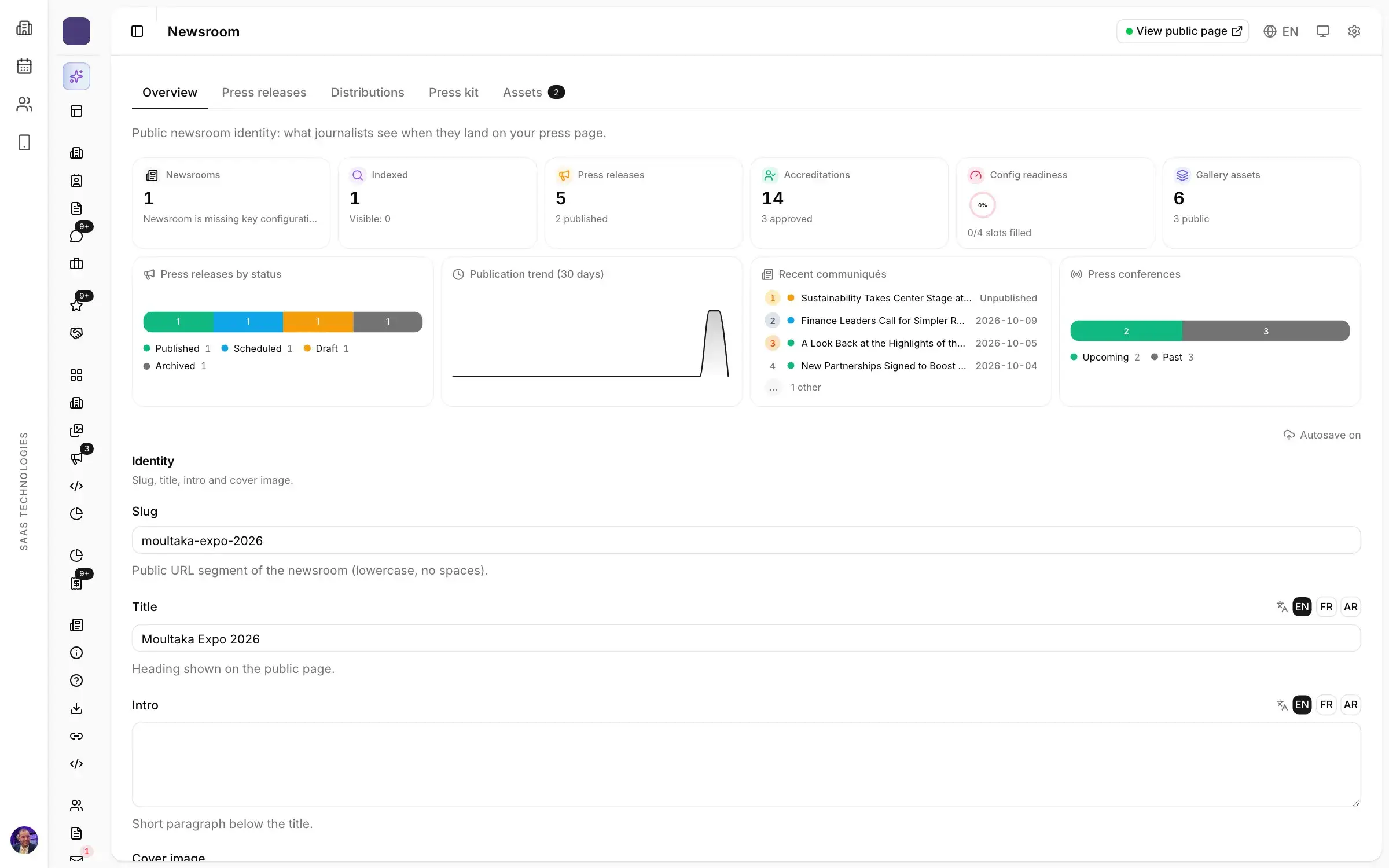
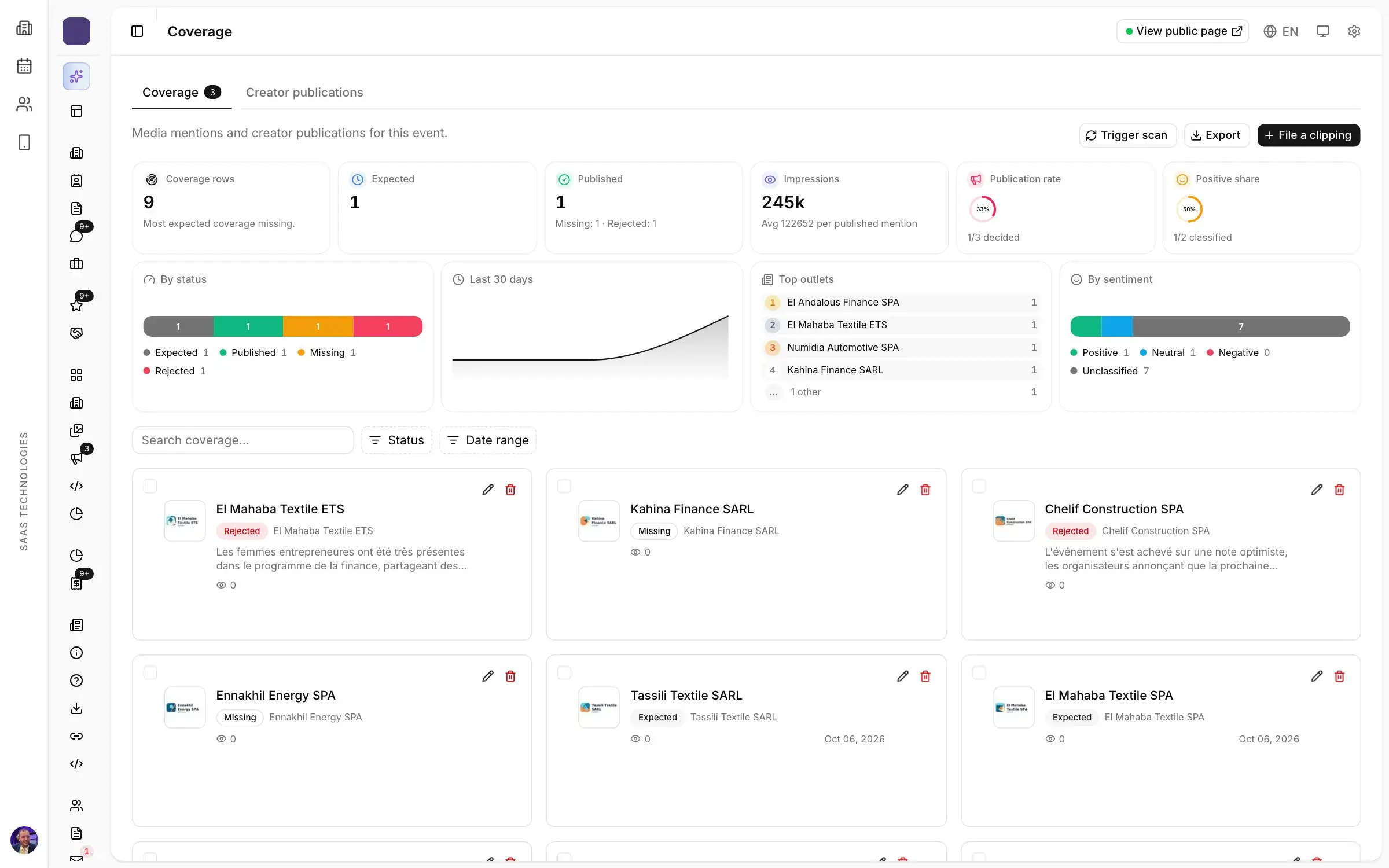
In Moultaka, the Press and media relations module keeps your press list, lets you draft releases, schedule them under embargo and send them to your list in one flow, publishes a public newsroom with a press kit generated as a PDF and a photo gallery, then tracks the coverage after the show with impressions and sentiment. To see it on your own show, book a demo.