Trade show press accreditation: how to get media coverage for your event
Media coverage for a trade show starts with press accreditation: the form, who qualifies, the badge, an online newsroom and the clippings you count after.
By Moultaka team
To get media coverage for a trade show, you need more than a press release. You need a press accreditation process that tells journalists how to apply and who qualifies, a reason to come on a given day, a newsroom where they find what they need at any hour, and a list of the articles you expect, checked after the show. Treat the press as an audience of its own, with its own registration, and coverage stops depending on luck.
The press accreditation process, step by step
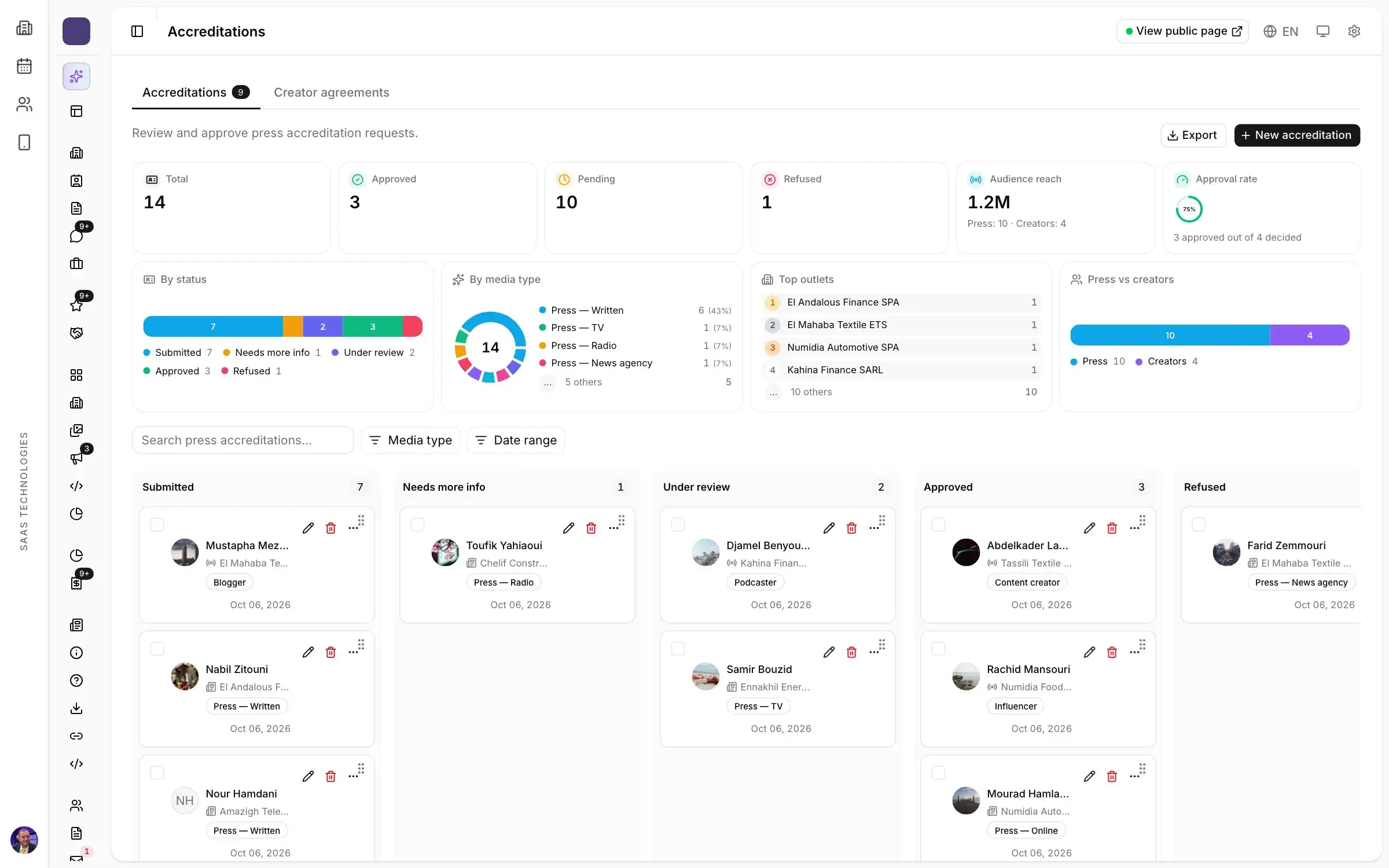
Accreditation is the media’s registration form, with a review in the middle. A process that holds up has four stages:
- The application. A press accreditation form, separate from visitor registration, linked from your homepage and your releases.
- The review. Each request is checked against criteria you wrote in advance. Incomplete files get a request for more information rather than a refusal.
- The decision. Approved or declined, with a short answer either way. A journalist left without a reply does not apply next year.
- The badge. Printed only once the request is approved. That rule alone keeps the press area for the press.
Open accreditation the same day as visitor registration. Large international shows open theirs months ahead; for a regional or national show, six to eight weeks is usually enough for the trade press to plan.
What the accreditation form should ask
Keep it short, and ask only what helps you decide:
- name, role and outlet, with the outlet type: print, TV, radio, online, news agency;
- what they plan to cover: the opening, a conference, a sector, a specific exhibitor;
- proof of assignment: a press card, a letter from the editor or a commissioning email, especially for freelancers;
- what they need on site: an interview, a seat at the press conference, photo access.
The outlet’s audience is worth asking too. It tells you where to spend your time when twenty requests arrive on the same morning.
Who qualifies: journalists, creators and everyone else
Write your media accreditation policy before the first request, not while answering it:
- which outlets you accept: general press, the trade press of your sector, broadcast, online media;
- how you treat content creators: bloggers, podcasters, specialist accounts. At many business events they now reach the exact audience exhibitors want. Give them their own category and their own criteria, rather than refusing them or mixing them with journalists;
- how many badges per outlet, for a TV crew as for a weekly;
- what you do not accredit: exhibitors’ marketing staff, agencies selling services to exhibitors, friends of the team.
Give the media a reason to come
Accreditation fills nothing on its own. A schedule that works for most trade shows:
- Four weeks before: an announcement release with the dates, the venue, what is new this edition and the accreditation link.
- One week before: a media invitation to the opening or a press briefing, with the time, the entrance to use and the name of the person who will meet journalists.
- On the day: a short press conference with seats kept for accredited media, and interviews already arranged with speakers and exhibitors.
- Every evening of the show: a short wrap-up release with photos ready to publish.
The same calendar fits inside your trade show planning timeline, next to the invitation emails to visitors.
An online newsroom journalists bookmark
A reporter filing at 10 p.m. does not call your press officer; they look for a page. Your online newsroom should hold:
- press releases, published on their date or held under embargo until the hour you set;
- a downloadable press kit with the key figures of the edition, the programme and the organizer’s contacts;
- a gallery of high-resolution photos cleared for press use;
- one named contact for media relations.
Put its address in every release and in the email that confirms an accreditation. A newsroom that keeps the same address works again for the next edition.
Count the coverage, for you and for your sponsors
After the show, someone always asks what the press said. To answer it, list the articles you expect, outlet by outlet, from the approved accreditations. Tick the ones that appear, file each clipping by outlet, and follow up on the missing ones a few days later. Track creators’ posts the same way.
Sponsors read this list closely: they paid for visibility and want to see where the show was mentioned, and how many people saw it. It belongs in the same report as their other benefits, as explained in trade show sponsorship renewals. And if the show runs a conference programme, the press conference is planned like any other session, as in how to organize a conference.
In short
Media coverage for a trade show comes from a process, not a single release:
- a press accreditation form, opened with visitor registration;
- criteria written in advance, creators included;
- a badge printed only after approval;
- releases, a press conference and interviews on a schedule;
- an online newsroom, and a coverage list checked after the show.
In Moultaka, Press & media relations brings accreditation requests from your press form into one place, with each outlet and its audience next to the name, alongside your press list, releases scheduled or under embargo, a press kit generated as PDF, press conferences where accredited media book a seat, and coverage tracked after the show. To see it on your own show, book a demo.