Event marketing plan for a trade show: template and example timeline
An event marketing plan for a trade show fits on one page. What goes in it, an example timeline from day -180 to day +7, and a template to copy.
By Moultaka team
An event marketing plan for a trade show fits on one page: who you are talking to, what each of them needs to hear, on which channel, on what date, and who sends it. A trade show has to sell twice, once to exhibitors and once to visitors, and it has to start with the exhibitors, six months out. Below: what goes in the plan, an example timeline you can adapt, a template to copy, and the numbers that tell you whether it worked.
What goes in an event marketing plan
Most templates run to many tabs. A show team needs seven lines, each of which can be checked:
- Targets in numbers: exhibitors signed, visitors registered, visitors who came, articles published. “Raise awareness” cannot be checked.
- Audiences: exhibitors, trade visitors, press, sponsors and institutional partners.
- One message per audience, in a sentence.
- Channels you will use, and the ones you are dropping this year.
- Dates, tied to your trade show planning timeline.
- One owner per send: a person, not “marketing”.
- Cost, line by line, carried into your trade show budget.
Start from last year’s post-show report: where registrations came from, which exhibitors left, what the press actually ran. A plan written without it pays for the same mistakes again.
Selling twice: four audiences, four messages
| Audience | Their question | What you tell them |
|---|---|---|
| Exhibitors | Who will be there, and is it worth a stand? | “Buyers from your sector will attend, and here is who they are.” |
| Trade visitors | What do I get from a day away from the office? | “These exhibitors, this session, these meetings to book.” |
| Press | What is new this year? | One fact: a new sector, a delegation, a number. |
| Sponsors and partners | What exposure, and what proof afterwards? | “Here is what you get, and what we will show you after.” |
Visitors come for exhibitors, and exhibitors sign because they expect visitors. Last edition’s numbers break that circle. At a first edition, your early signatures do, announced one at a time with each company’s agreement. Our guide on how to get exhibitors for an event covers the sales side.
Event marketing plan example: day -180 to day +7
Treat these dates as a starting point. A smaller show can compress them, but should keep the order.
| When | Audience | What goes out | Channel |
|---|---|---|---|
| Day -180 | Past exhibitors | Dates, venue, last edition’s numbers, floor plan open | Email, phone |
| Day -150 | New exhibitors | Show overview, floor plan, stand offer | Email, LinkedIn, neighbouring shows |
| Day -120 | Sponsors | Sponsorship packages | Meetings, email |
| Day -90 | Press | First release: dates, theme, first exhibitors | Press list, newsroom |
| Day -60 | Visitors | Registration opens, first invitation email | Email, website, social |
| Day -45 | Exhibitors | E-card, banner and link to invite their own customers | Email, exhibitor manual |
| Day -30 | Press, visitors | Conference programme, second release, press accreditation | Press list, website, social |
| Day -21 | Not yet registered | Second wave, from a different angle | |
| Day -7 | Registered | Reminder: what they will find on site | Email, WhatsApp |
| Day -3 | Press | Opening invitation, with the time and the gate | Email, phone |
| Day -1 | Registered | Hours, access, parking, which entrance | Email, WhatsApp |
| Show days | Everyone | News, photos, programme changes | App, social, newsroom |
| Day +1 | Attended, no-shows | Thanks to one group, a word to the other | |
| Day +7 | Exhibitors, sponsors, press | The edition’s numbers, next year’s dates | Email, press release |
The reminders on day -7 and day -1 do more than they appear to: they are part of what moves your event no-show rate.
Choosing channels when your show is international
Begin with what has already brought people to your show, and add one channel at a time.
- Email is the channel for exhibitors and past visitors. The list is yours, and no algorithm stands between you and it.
- LinkedIn reaches decision-makers and exhibitor sales teams, and is where trade audiences check who else is going.
- WhatsApp suits short reminders in many markets, the Gulf and North Africa among them, for people who opted in. It does not replace the invitation.
- Trade media and associations speak to people you cannot reach alone. Give them a real story and a date, well before their deadlines.
- Your exhibitors: one who invites their own customers fills your aisles and builds their own case for rebooking.
- Language: if your visitors read Arabic, French or English, write for each. A translation pasted under the main text reads like one.
Track every channel with its own link
If one registration link goes everywhere, you learn nothing. Give each channel its own tracked link or QR code: email, LinkedIn, a partner’s site, a printed poster. Four numbers then tell the story:
- Registrations by source, week after week.
- Invited, registered, attended: a channel that registers many and delivers few is worth less than it looks.
- Articles expected, published and missing: press coverage can be counted.
- Cost per attendee, channel by channel: the number that sets next year’s budget.
Read these every week, and change the plan while it can still change the result. At day -30, money can still move from one channel to another.
Five mistakes that waste a marketing plan
- Starting a month out. Exhibitors decided long before, and decision-makers have filled their calendars.
- One message for everyone. Visitors do not need the stand offer. Exhibitors do not need the parking map.
- Talking about the show instead of the reader. “The must-attend event” says nothing; “forty packaging manufacturers under one roof” speaks to a buyer.
- Press releases with no news. Two that say something beat six that repeat the dates.
- Stopping at closing time. The weeks after the show are when next year’s rebooking begins.
Event marketing plan template
Copy this and fill in the brackets:
Show: [name], [dates], [venue]
Targets: [n] exhibitors · [n] registered · [n] attended · [n] articles
Exhibitors: message [one sentence] · channels [which] · owner [name] · cost [amount]
Visitors: message [one sentence] · channels [which] · owner [name] · cost [amount]
Press: this year’s news [one fact] · channels [which] · owner [name] · cost [amount]
Sponsors and partners: what they are promised [list] · owner [name]
Every Monday: registrations by source · invited, registered, attended · articles published · this week’s decision
In short
An event marketing plan for a trade show says who you are talking to, what you tell them, where, when and who sends it. It fits on one page, starts with exhibitors and carries on after the doors close. One link per channel then shows you where the money should go.
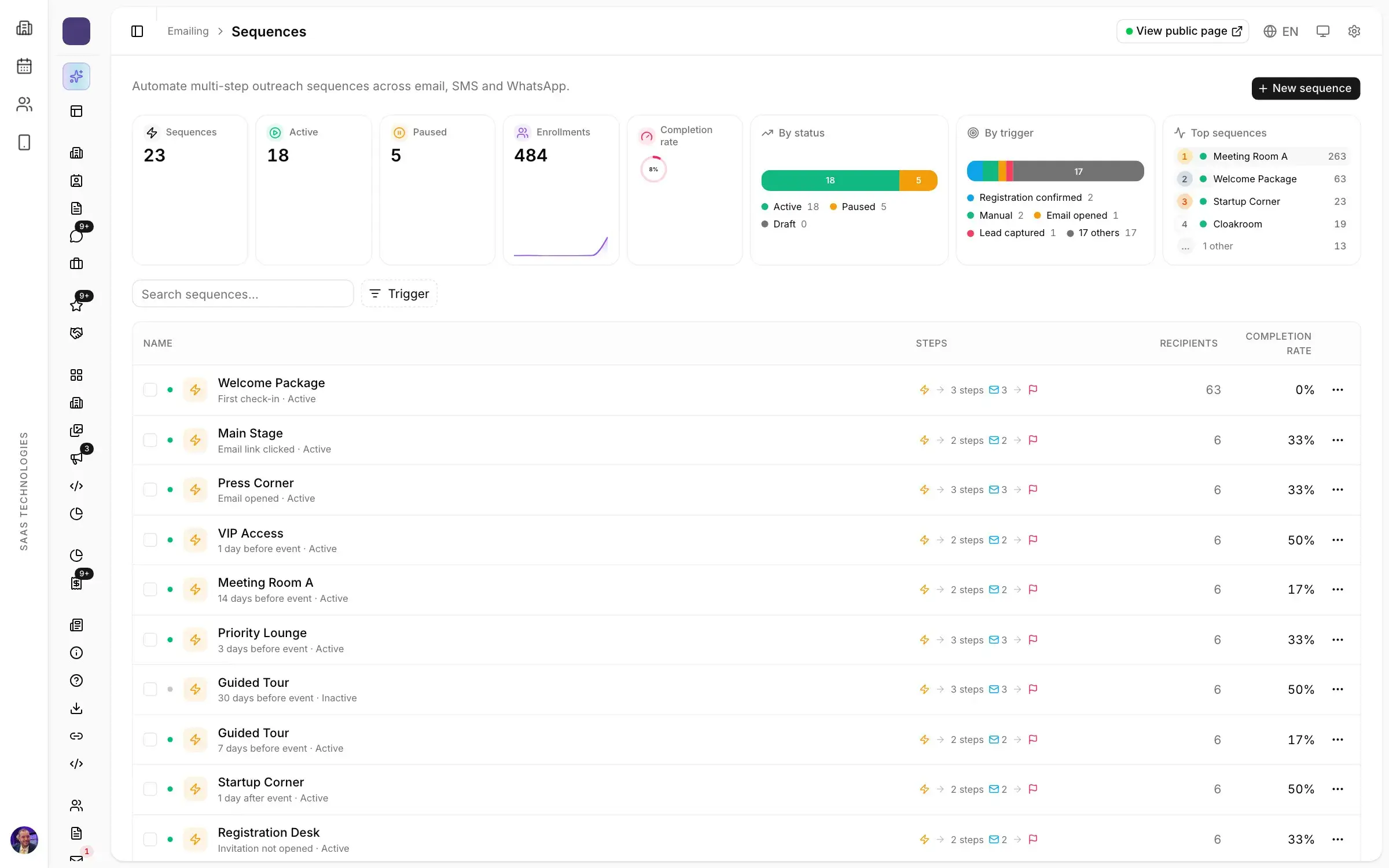
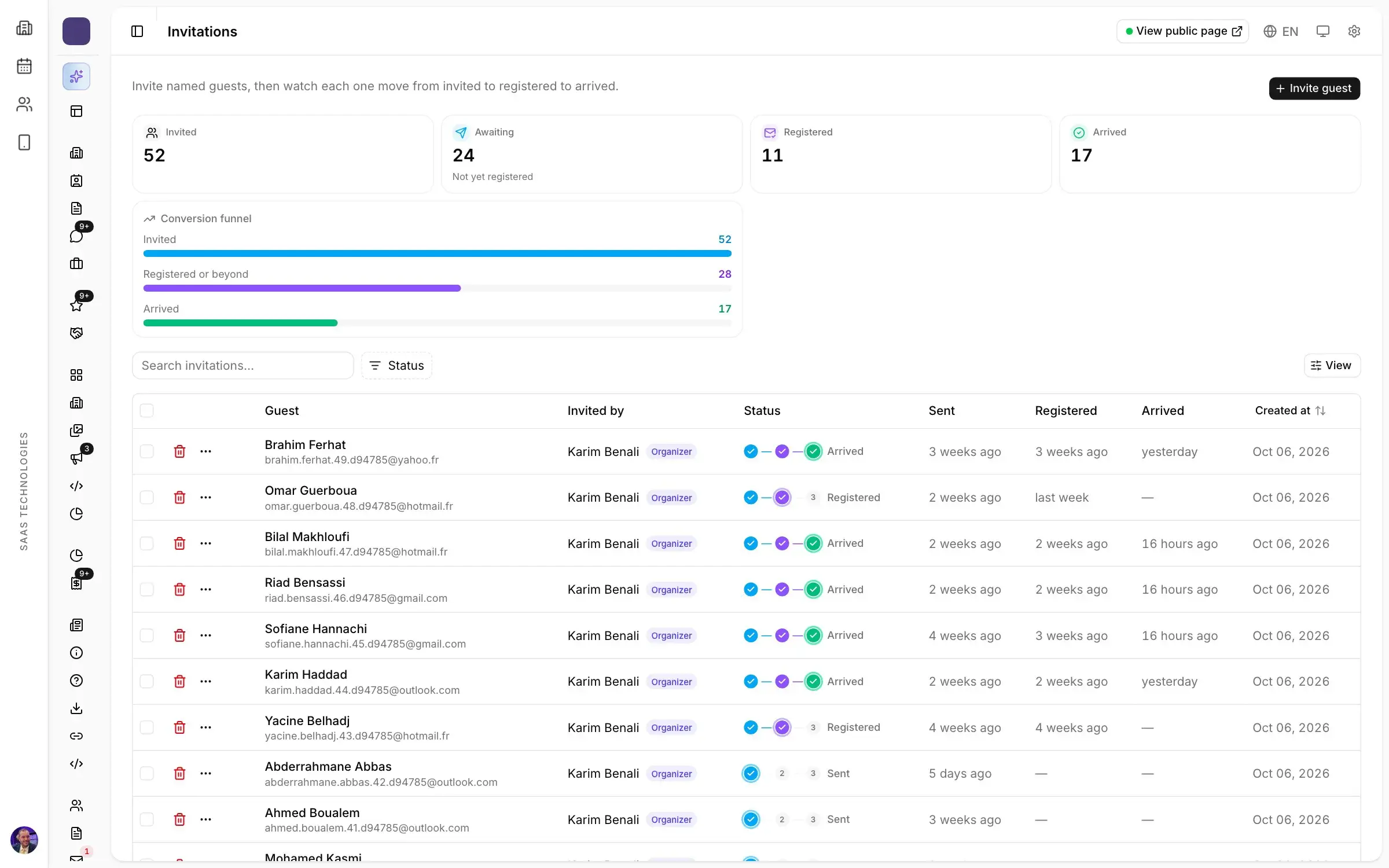
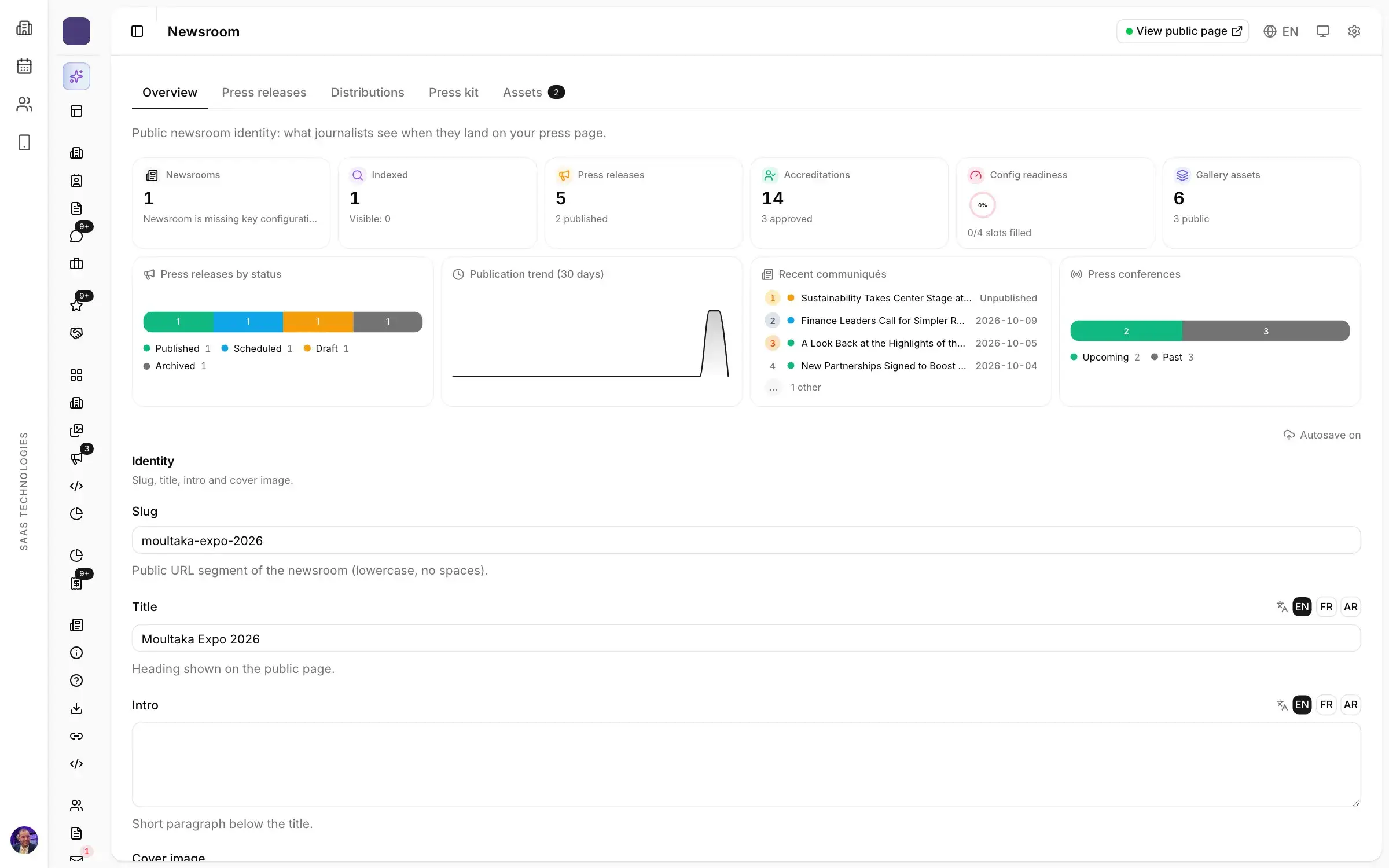
In Moultaka, campaigns and sequences run from the same database as registration: segments recalculated before every send, email and WhatsApp templates, and trackable links and QR codes for every channel, with clicks by source and by country. The press office holds releases scheduled or under embargo, the press kit and the coverage, and the event app for B2B trade shows takes over on opening day with push notifications. To see this plan on your own show, book a demo.