Conference organizing committee roles and responsibilities
Conference organizing committee roles and responsibilities: who sits on it, what each member owns, how it works with the program committee, and a timeline.
By Moultaka team
A conference organizing committee runs everything except the content: venue, budget, registration, hospitality, marketing, sponsors and the logistics of the day itself. The program committee (called the scientific committee at academic events) decides what is said: it writes the call for papers, reviews submissions and builds the agenda. For a conference of 150 to 300 delegates, five to eight people on the organizing committee is enough, as long as each one owns a clear area with a budget and deadlines. Below: the roles and responsibilities of each member, how the two committees work together, a meeting timeline from six months out to one month after, and the mistakes that cost the most.
Three bodies, three jobs
Most conferences, academic or professional, have up to three bodies. When their jobs blur, decisions stall.
| Body | What it decides | Who sits on it | Typical size |
|---|---|---|---|
| Advisory or honorary board | Nothing operational: it lends names and credibility | Senior figures, institutional partners, past chairs | 3 to 8 |
| Program committee (scientific committee) | Themes, call for papers, which submissions are accepted, the agenda | Experts in each track, including people from other institutions | 8 to 15 |
| Organizing committee | Venue, budget, registration, hospitality, marketing, sponsors, logistics | The host team: staff, volunteers, graduate students | 5 to 8, plus on-site volunteers |
Large association congresses often split the organizing committee further, with a local organizing committee (LOC) on the ground in the host city and a central committee at the association. The principle stays the same: one body decides the content, another delivers the event.
Conference organizing committee members and what each one owns
Split the work into areas, give each area to one named person, and write it down. An area that belongs to everyone belongs to no one.
| Role | What they own |
|---|---|
| Chair | Final calls, the link with the program committee, the host institution and VIPs |
| Secretary | The master timeline, meeting notes, official correspondence, the conference inbox |
| Treasurer | The budget, quotes, commitments, payments and the final financial report |
| Registration lead | The registration form, attendee lists, badges, check-in, certificates of attendance |
| Logistics lead | Rooms, audio-visual, catering, speaker travel and accommodation |
| Marketing lead | The website, email campaigns, social media, press, photography on the day |
| Sponsorship lead | Sponsor packages, contracts, deliverables, exhibition tables if any |
On a smaller event one person can hold two roles: secretary and registration pair well, as do marketing and sponsorship. The one combination to avoid is chair and treasurer. The person who makes the final call should not also be the person who signs the payments.
Volunteers and graduate students are the backbone of the committee on the day. Give each one a defined job and a named supervisor rather than a list of chores: one room, one session’s speakers, the certificates desk.
The program committee: roles and responsibilities
The program committee carries the conference’s reputation. Its names go on the call for papers, and authors look at them before deciding to submit.
It has four jobs:
- Set the theme and tracks, checking with the organizing committee what the venue can actually hold.
- Write the call for papers or call for speakers: tracks, abstract format, deadlines, accepted languages. Our call for speakers and call for papers template gives the structure.
- Review submissions: two reviewers per abstract, blind, with a shared scoring grid. The format and the grid are in our conference abstract template.
- Build the agenda: group accepted papers into sessions, name a chair for each session, invite the keynote speakers.
Aim for balance over size: specialists for every track, members from other institutions and other countries, and people who will genuinely read. A committee of thirty names where ten do the reviewing is a committee of ten with a delay built in. Get each member’s written agreement before you publish their name, and tell them how many abstracts to expect and by when.
Where the two committees must decide together
Most of the time each committee works on its own. Three points force a joint decision:
- Kick-off (six months out): theme, dates, venue, room capacity and the number of session slots. The program committee cannot accept 120 papers if the organizing committee has two rooms for two days.
- Acceptance (two months out): the list of accepted papers fixes how many speakers you host, sometimes house, and print in the program.
- Final agenda (three weeks out): session order, chairs and times, which then go to print, to the website and to the app. Our conference agenda template helps lay it out.
Between those points, a short email update between the two chairs every two weeks is enough. Name one person, usually the secretary, to keep the decision log both committees work from.
A meeting timeline for the organizing committee
| When | Meeting | What must come out of it |
|---|---|---|
| 6 months out | Kick-off, both committees | Theme, dates, venue, draft budget, roles assigned |
| 5 months out | Organizing committee | Call for papers live, website up, first quotes |
| 3 months out | Organizing committee | Registration open, sponsors confirmed, rooms booked |
| 2 months out | Both committees | Accepted papers, speakers invited, travel and hotels started |
| 1 month out | Organizing committee | Final agenda, badges, certificates, room plan, volunteer rota |
| 1 week out | Full organizing committee | Walk-through of the day, run of show checked, every post filled |
| 1 month after | Both committees | Financial report, conference report, proceedings, thank-you emails |
Keep each meeting to an hour, with an agenda sent the day before and one page of minutes the day after: decisions, owners, deadlines. The day itself runs on a run of show, not on a meeting.
On the day: from committee to floor team
On conference day the organization chart changes. The committee becomes a floor team and each member has a post:
- an event lead, reachable by phone and free of any other job;
- a room manager per room, who keeps time and warns the session chair five minutes before the end;
- the registration desk, for badges, check-in and questions;
- a speaker liaison, who collects slides, greets keynotes and handles their expenses;
- rapporteurs, one per session, who feed the conference report.
Program committee members chair the sessions and moderate the panel discussions. The program chair often gives the closing summary.
Mistakes that cost the most
- Publishing committee names without asking. A reviewer who finds their name on a poster will not review.
- A treasurer who learns about spending after the invoice. Every commitment goes through them before the order, not after.
- No secretary. Without minutes, every meeting re-runs the last one.
- Letting the program committee accept more papers than the rooms can hold. Capacity is fixed at kick-off and does not move.
- Running everything from personal inboxes. When a member leaves or falls ill, their threads go with them.
One committee, one place to work
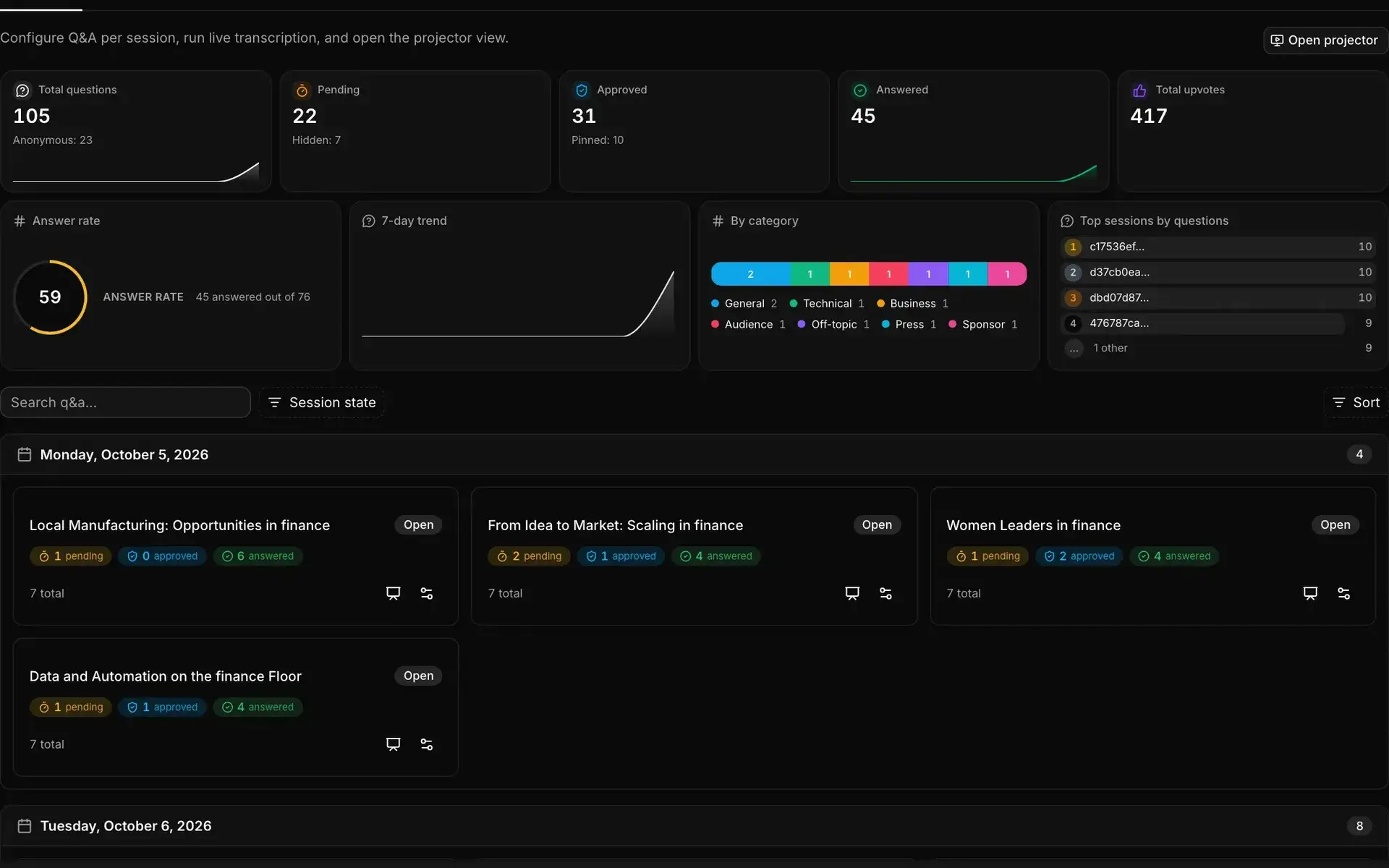
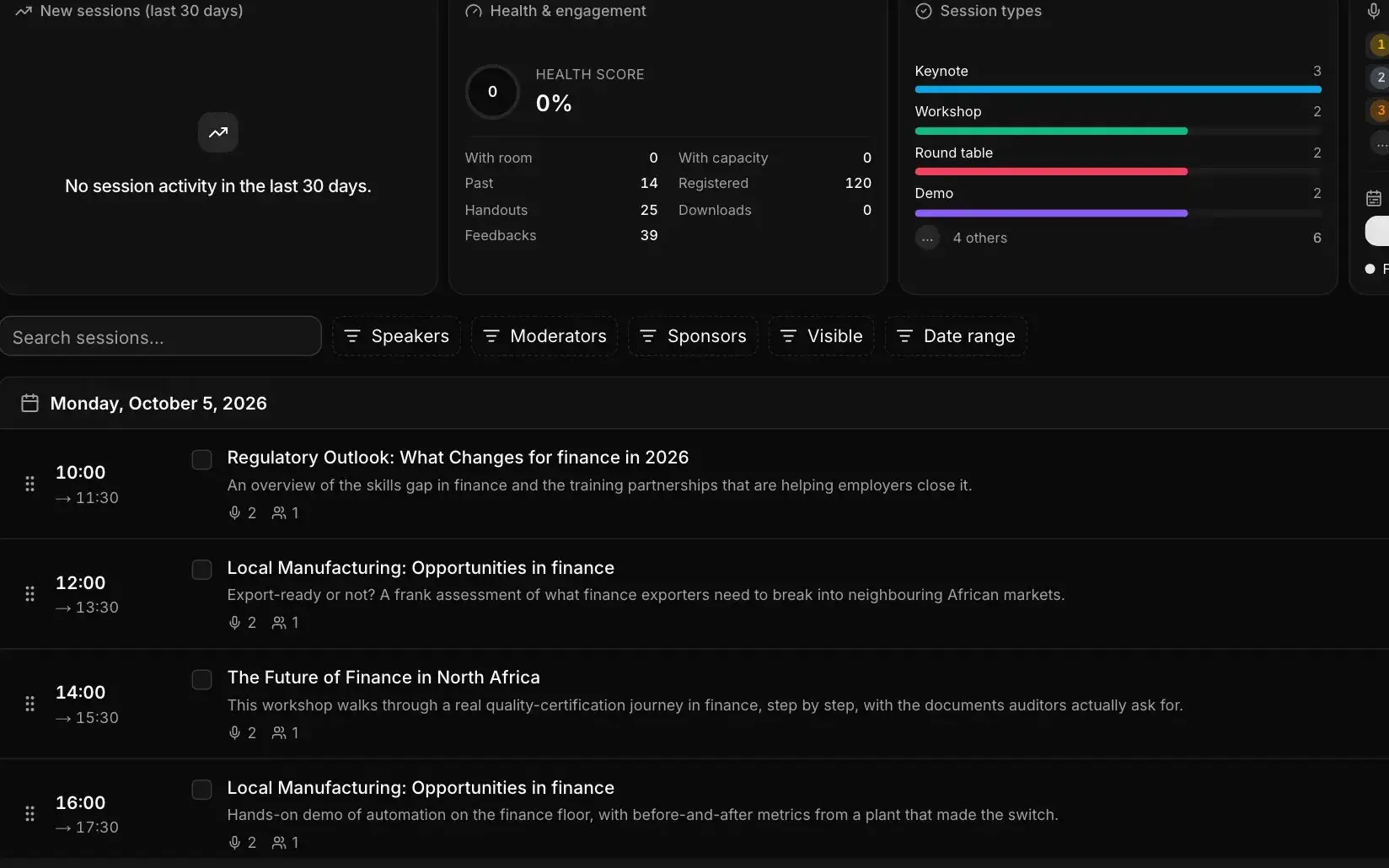
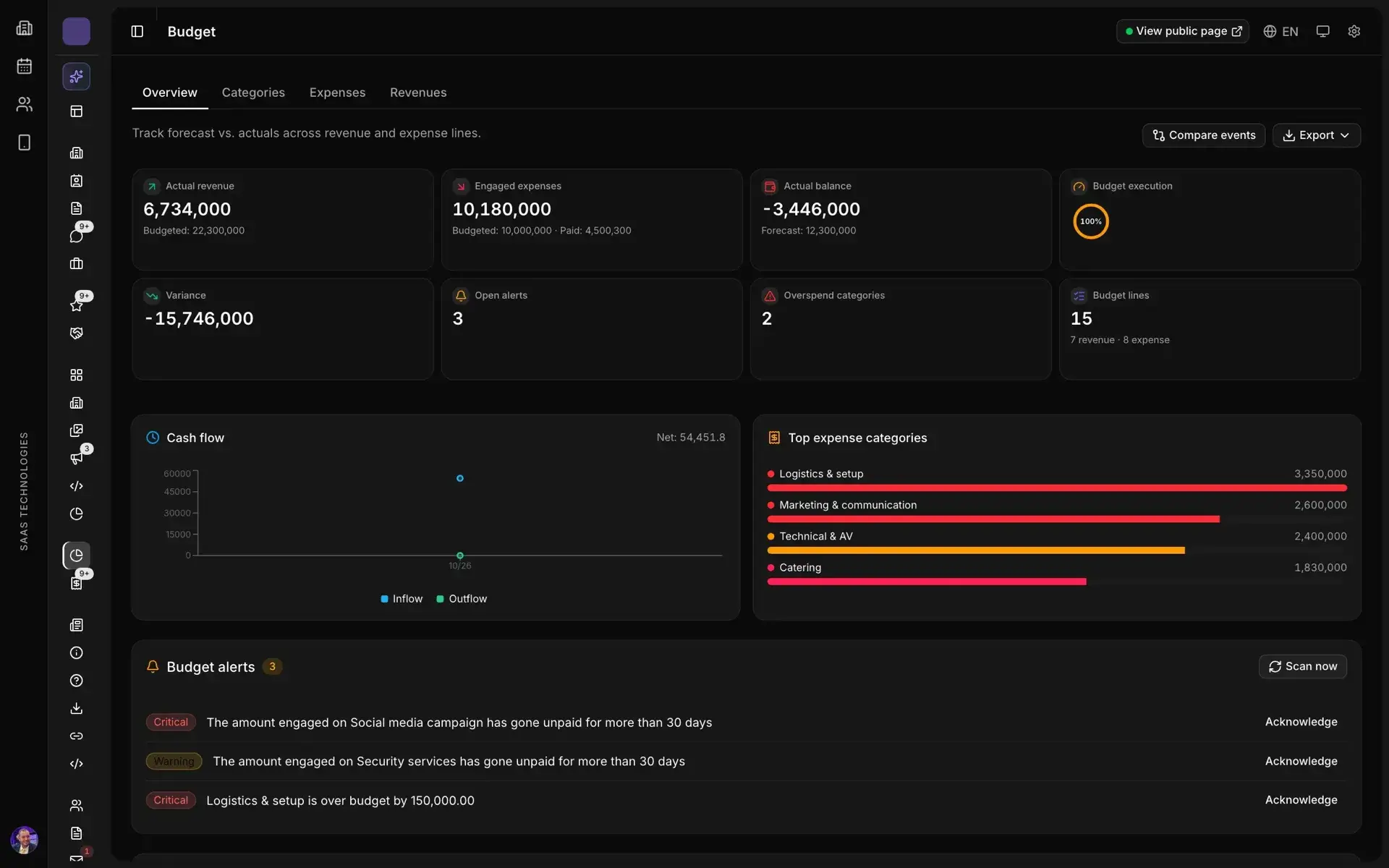
When every area keeps its own spreadsheet, committee meetings turn into reconciling numbers. In Moultaka the organizing team works in one place, and each team member sees the tools and data their role allows, from director to front desk. Applications, profiles, sessions and ratings for every speaker sit together, and the session schedule is published to the website and the app as soon as you save. The treasurer follows budgeted, committed and paid amounts by category and supplier, with alerts before a line goes over. The Conferences module covers the agenda and speakers, and Analytics, budget and AI covers the budget. To see both on your own conference, book a demo.