Conference abstract template, an example, and how to build a book of abstracts
A conference abstract template to give authors, a worked example, the scoring rubric for reviewers, and how to build the book of abstracts.
By Moultaka team
A conference abstract template is the format every author must follow when proposing a paper: a title, the authors and their affiliations, the track, and a single paragraph of 250 to 300 words covering the question, the method, the results and the conclusion, followed by three to five keywords. The organiser sets it in the call for papers, because three things depend on it. The scientific committee accepts or rejects on the abstract alone; the programme is built from it; and the same text is printed in the book of abstracts that every delegate receives at registration. Leave the format open and you will spend the week before the conference reformatting. Here is what an abstract contains, a template to paste into your call, a worked example, the rubric reviewers score against, and how to put the book of abstracts together without losing nights to it.
What a conference abstract contains
| Part | What goes in it | Typical length |
|---|---|---|
| Title | The topic and the setting, no acronyms | One or two lines |
| Authors and affiliations | Name, position, department or lab, institution, country, email | Two lines per author |
| Track | The track number as listed in the call | One word |
| Background and aim | The question the paper answers, and why it matters | Two or three sentences |
| Methods | The approach, the setting, the sample or the material | Two or three sentences |
| Results | What the work found, or what it expects to find if it is ongoing | Three to five sentences |
| Conclusion | What the paper adds to the conference theme | One or two sentences |
| Keywords | Three to five, separated by commas | One line |
No references, tables or figures in an abstract: those belong in the full paper or on the poster. Medical and scientific societies often ask for a structured abstract, with the four headings Background, Methods, Results and Conclusion written out; humanities and management conferences usually prefer one unbroken paragraph. Say which one you want.
A conference abstract template to paste into your call
Add this to your call for papers, as it is or with the numbers in brackets changed:
Title: [title]
Presenting author: [Full name], [position], [department / lab], [institution], [country], [email]
Co-authors: [same details for each]
Track: [number and name]
Presentation language: [English / French / Arabic]
Preferred format: [oral presentation / poster]
Abstract: [250 to 300 words: background and aim, methods, results, conclusion]
Keywords: [three to five]
Conflicts of interest and funding: [one line, or “none”]
Then two lines of rules under it: the word limit as a number, no references or tables, the deadline with its time zone, and whether an abstract that misses the format is returned or rejected. A word limit is clearer than a page limit: everyone’s page is a different size. Many committees also hand out the template as a Word file; if you do, keep the form fields identical to it so nothing is lost between the two.
A conference abstract example
A fictional example, as it would read in the book of abstracts:
Welcoming international visitors at trade shows in North Africa: a survey of exhibitors
[Full name], Senior Lecturer, [department], [university], Algeria — Track 3
Trade shows in North Africa receive a growing number of international visitors and trade delegations, yet their experience, from registration to the stands, has drawn little research. This paper identifies the obstacles international visitors meet, as exhibitors see them. We surveyed exhibitors at three trade shows in Algiers and Oran and interviewed their organisers. Language, signage in the halls and getting a badge at the entrance were the obstacles cited most often; exhibitors who received the visitor list in advance booked more meetings. We conclude that the quality of the welcome is built before the doors open, and we propose five recommendations for organisers.
Keywords: trade shows, international visitors, exhibitors, visitor experience, North Africa
Note the order: one sentence of context, the aim, the method, the results, the conclusion. When the work is still running, the abstract says so: “preliminary results will be presented” reads better than results stretched to fit.
Reviewing abstracts: the scoring rubric
Each abstract goes to two reviewers from the scientific committee, without the author’s name or institution, and is scored on the same rubric:
| Criterion | The reviewer’s question | Score |
|---|---|---|
| Relevance | Does the paper answer one of the conference tracks? | 0 to 5 |
| Question | Is the research question clear and specific? | 0 to 5 |
| Method | Are the approach and setting stated, and appropriate? | 0 to 5 |
| Results | Are there results, or a clear statement of what is expected? | 0 to 5 |
| Contribution | Does it add something to what is already known? | 0 to 5 |
| Format | Were the rules followed (length, language, keywords)? | 0 to 5 |
Three outcomes: accepted for oral presentation, accepted as a poster, declined. When the two reviewers differ by more than ten points, a third decides. Send the decisions on the date you announced, with a short reason when you decline: an author who hears back politely submits again next year. And as soon as a paper is accepted, authors travelling from abroad need a visa invitation letter.
The book of abstracts: how to put it together
The book of abstracts collects the abstracts of every accepted paper; delegates receive it with the programme. The usual order:
- Cover: conference name, edition, dates, venue, the logos of the host institution and partners.
- A welcome from the conference chair, one page.
- Committees: honorary chair, scientific committee, organising committee.
- The programme at a glance, day by day, with a code for each session.
- The abstracts, grouped by session in programme order, each with its code (S2-03: session 2, third paper), which the programme also shows.
- Posters, in a section of their own.
- Author index, alphabetical, with the codes of their papers.
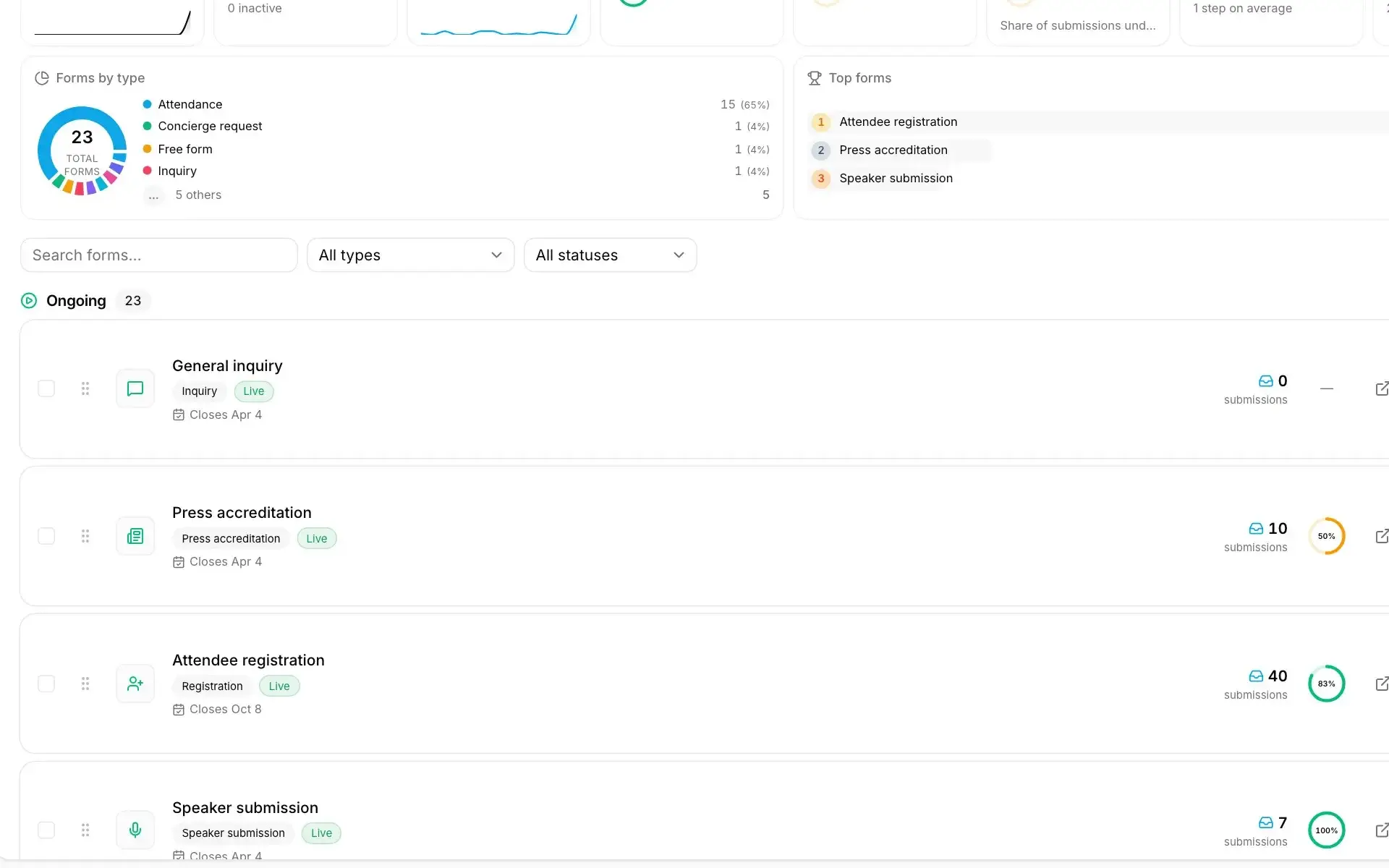
What makes a book of abstracts a one-day job rather than a one-week job is that every abstract arrives with the same fields. When abstracts come in by email, as attachments in every format, someone on the committee spends the nights before the conference retyping titles and fixing names. When they come in through a submission form with fixed fields (title, authors, institution, track, an abstract with a word limit, keywords), the book is a matter of sorting and assembling, not rewriting. Authors who write in LaTeX can still paste plain text into the form.
Publish the book of abstracts as a PDF on the conference page two or three days before opening, print enough copies for reviewers and official guests, and put a QR code at registration for delegates who want it on their phone. After the conference, full papers go into the proceedings or a special issue of a journal: a different document, with its own editors and deadlines, which we place in context in our conference report template.
Mistakes that cost the committee time
- A call with no word limit: you will get 80-word abstracts and three-page ones.
- An abstract with no results: a description of the topic that never says what was found, and cannot be scored.
- Author names spelt three ways across the form, the abstract and the programme: the certificates come out wrong.
- Machine-translated abstracts nobody re-read, in a multilingual conference.
- Edits accepted after acceptance with no cut-off date: the book never closes.
- A printed book listing withdrawn papers: update the list three days before it goes to print.
After the abstracts: the agenda and the certificates
Accepted papers become an agenda: start from our conference agenda template, and at the close give each author a certificate of attendance showing the title of their paper exactly as it appears in the abstract. For the whole picture, from the scientific committee to the closing session, read how to organize a conference.
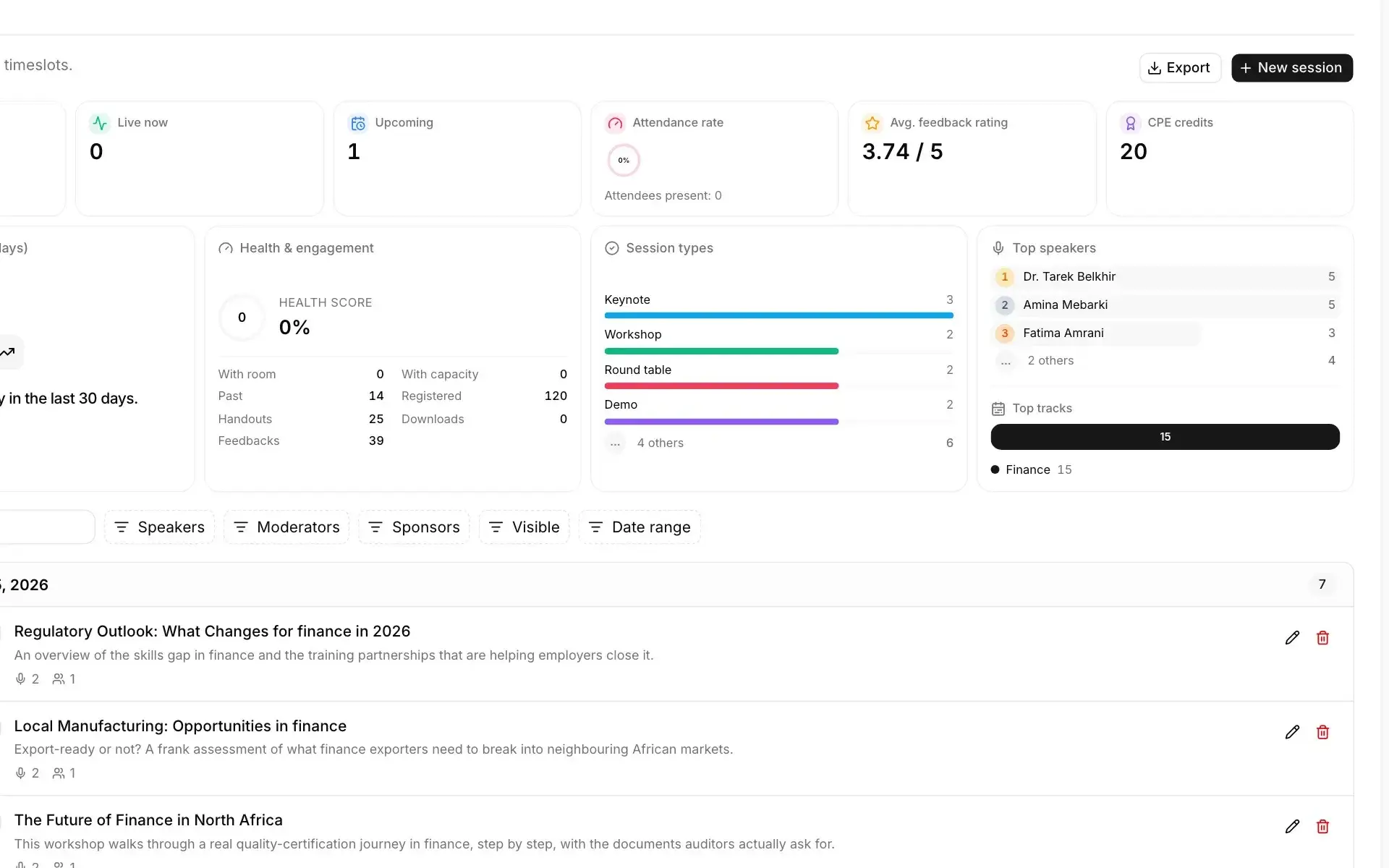
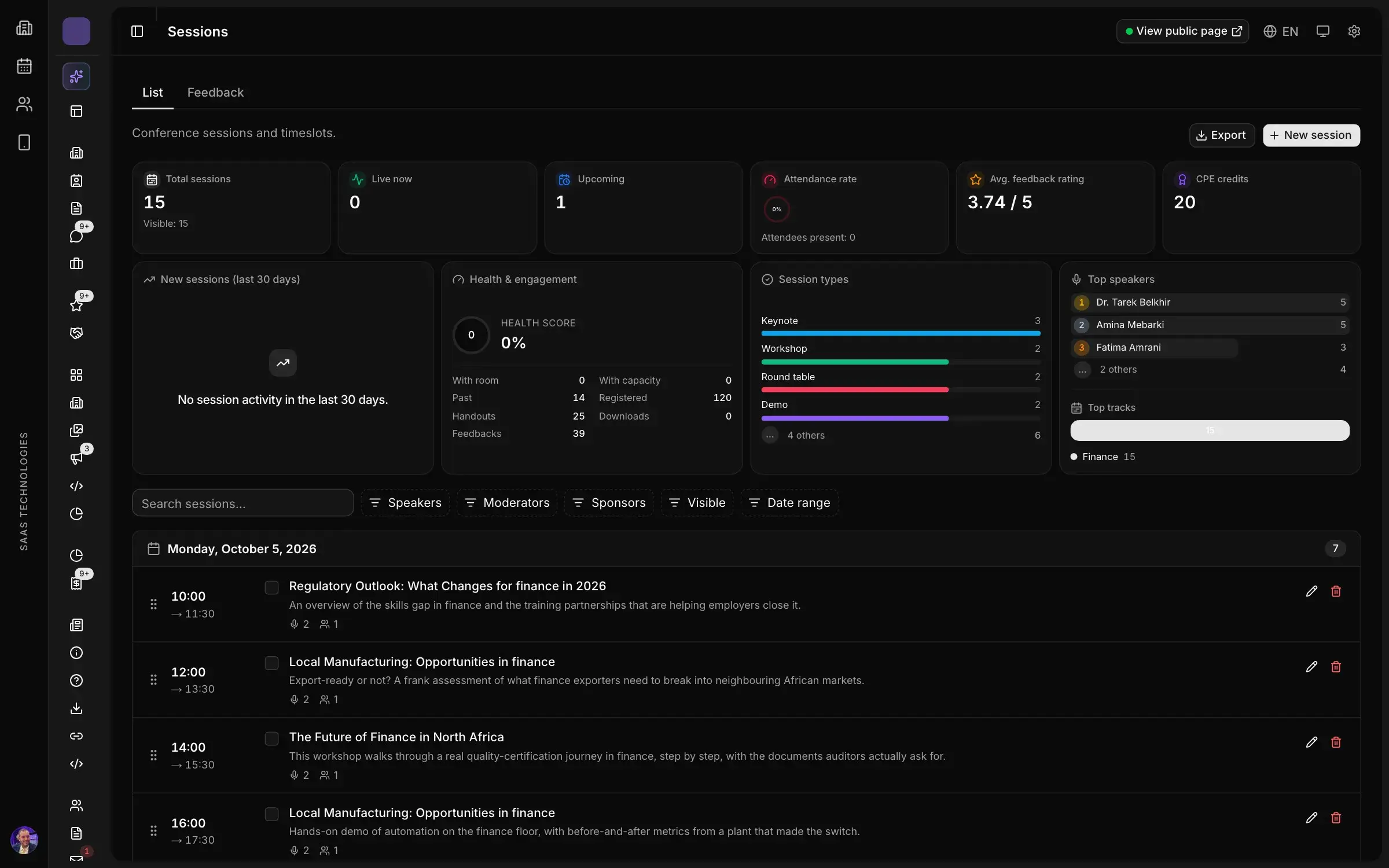
In Moultaka, the speaker submission form is built without a developer, with its conditions, and you follow completion and drop-off rates. Applications, profiles, sessions and ratings for every speaker and panellist sit in one place, and sessions, rooms, speakers and formats live in one schedule, published to the event website and the app as soon as you save. See the Conferences & engagement page, and to see your next conference in it, book a demo.