Call for speakers and call for papers template: how to write one for a conference
How to write a call for papers or a call for speakers: topics, timeline, the submission form fields, a template to copy and an example for a trade show.
By Moultaka team
How do you write a call for papers, or a call for speakers, for a conference? Answer six questions on one page, in this order: what the event is about, which topics you want proposals on, who can submit and in what language, what to send (an abstract or a session proposal, and how long), by when, and where. Everything else, the committees, fees, travel support and a contact, comes after. A clear call brings more submissions and, above all, better ones: a speaker weighing three calls picks the one that tells them in two minutes whether their work belongs. Below: the difference between the two kinds of call, what goes in each, a timeline, a call for papers template to copy, an example call for speakers for a trade show conference, and the fields your speaker application form needs.
Call for papers or call for speakers?
| Call for papers | Call for speakers | |
|---|---|---|
| Typical event | Academic or scientific conference | Industry conference, trade show programme, summit |
| What people submit | An abstract, sometimes a full paper later | A session idea: title, short description, format |
| Who reviews | A scientific or programme committee, often blind | The programme team, sometimes with an advisory board |
| What gets judged | Research question, method, results | Relevance to the audience, speaker experience, no sales pitch |
| Output | Sessions of papers, sometimes proceedings | Keynotes, panels, workshops, case studies |
| Lead time | Six to nine months | Three to five months |
Many events sit in between: a professional congress with a scientific track, or a trade show whose conference programme mixes invited keynotes and open slots. Write the call for the people you want to hear from, not for the label.
What goes in a call for papers or call for speakers
- Title, dates and venue, in the first lines.
- Who is organizing, and the partners.
- The theme, in a few paragraphs: the context, what is still open, what the event wants to move forward.
- Topics or tracks: four to six, each with two or three lines on what you expect. They often become your sessions, so a topic that draws two submissions will not fill a room.
- Who can submit: researchers, students, practitioners, vendors (and on what terms).
- Formats: paper, talk, panel, workshop, poster, with their length.
- What to send: word limit, keywords, the chosen track, a short bio.
- Languages accepted, for the talk and for the abstract.
- Key dates: deadline, notification, final version or slides, the event.
- Fees and support: speaker registration, travel or accommodation if covered, and what is not.
- One link to the submission form, and one contact address.
A timeline that works
| When | Step |
|---|---|
| 9 to 6 months out | Call opens |
| 4 to 3 months out | Submission deadline |
| 3 to 2 months out | Authors and speakers notified, accepted and declined |
| 6 weeks out | Draft programme published, registration open |
| 3 weeks out | Final papers or slides, if required |
| 2 weeks out | Final programme |
| Event days | The conference |
| 3 to 6 months after | Proceedings, if any |
For an industry event, compress it: open the call for speakers four or five months out and close it two months before. Extend a deadline once, by a week or two, and announce it everywhere at the same time; a deadline moved twice teaches people to submit late. The call is also a marketing moment, so put its opening and its deadline in your trade show marketing plan, next to the save the date and the first invitations.
Call for papers template
Copy this and fill in the brackets:
Call for papers
[Conference title] [Dates] · [Venue, city, country]
About the conference. [Context in three or four sentences.] [What is still open.] [What the conference wants to move forward.]
Topics. We welcome submissions on, but not limited to:
- [Topic]: [what you expect, in two lines].
- [Topic]: [what you expect].
- [Topic]: [what you expect].
- [Topic]: [what you expect].
Who should submit. [Researchers, PhD students, practitioners in …]
Submission. An abstract of [300 to 500] words in [English / French / Arabic], with [five] keywords, the chosen topic and a [100-word] bio, through the online form: [link].
Key dates. Abstract deadline: [date]. Notification: [date]. Full paper: [date]. Conference: [dates].
Registration and support. [Fees for presenters.] [What is covered: accommodation, meals.] [What is not.]
Committees. Scientific committee: [chair, members]. Organizing committee: [chair, members].
Contact. [One address.]
Call for speakers example for a trade show conference
Trade show conference programmes need speakers who teach the audience something, not a line-up of sales presentations. An example to adapt:
Call for speakers: [Show name] conference programme, [dates], [city]
[Show name] brings together [who] from [which sectors and countries]. Our conference programme runs over [two] days on the show floor, and this year we are looking for speakers on:
- [Theme 1]
- [Theme 2]
- [Theme 3]
Formats. 20-minute talk, 45-minute panel, 60-minute hands-on workshop.
What we look for. Practical experience, real cases, numbers you are free to share, and a clear takeaway for a professional audience. Product presentations are not accepted in the programme; exhibitors who want to present their offer can book a demonstration on their stand.
How to apply. Send a session title, a 100-word description, the format and your bio through the speaker application form: [link]. Deadline: [date]. We reply to every proposal by [date].
Accepted speakers then go into the same programme as the rest of the show, and their sessions belong in your save the date email and invitations.
The speaker application form: fields to include
One form beats an inbox full of attachments in every format. Every proposal arrives with the same fields, and the committee does not start by retyping a spreadsheet.
| Field | Why you need it |
|---|---|
| Name, title or position | For the programme and certificates |
| Organization and country | For the programme, and visa letters for international speakers |
| Email and phone | For the notification |
| Track or theme | To share proposals among reviewers |
| Session or paper title | For the programme |
| Abstract or description, with a word limit | For the review |
| Format | Talk, panel, workshop or poster |
| Keywords | To group talks into sessions |
| Language of the talk | For room planning and, if any, interpretation |
| Short bio and photo | For the moderator’s introduction and the speakers page |
| Co-authors or co-panellists | So each one is in the programme |
Close the form on the deadline, at the stated time. Speakers travelling from abroad will need an invitation letter for their visa as soon as they are accepted; our guide to hosted buyer programmes and visa letters covers the letter.
Reviewing submissions: a simple scoring grid
Give every reviewer the same four criteria, scored 1 to 5: relevance to the theme, originality, clarity, and value for this audience. Add one line for a comment. Two reviewers per proposal is enough for most events; a third settles the disagreements. Then reply to everyone, declined proposals included: a short, courteous note keeps the author for your next edition.
Where to promote your call
- A page of its own on the event website, with the form: every other channel points there.
- Universities, research labs and professional associations in your field, through their mailing lists.
- LinkedIn, where practitioners and industry speakers look for stages.
- Call for papers and call for speakers listing sites, which repost calls as they are: one more reason the call should read on its own.
- A reminder two weeks before the deadline, and another three days before.
Mistakes that keep good speakers away
- A theme statement three pages long.
- Topics so broad they say nothing about what will be accepted.
- No word limit, so you receive 80-word abstracts and 15-page papers.
- Fees announced late, or vague travel support.
- Notifications that miss the promised date. Good speakers say yes to another stage.
- Silence for declined proposals.
After the call: building the programme
Once the committee has chosen, the accepted proposals become a programme: start from our conference agenda template, then prepare your session chairs with how to moderate a panel discussion. For the full sequence, from committees to certificates, see how to organize a conference step by step.
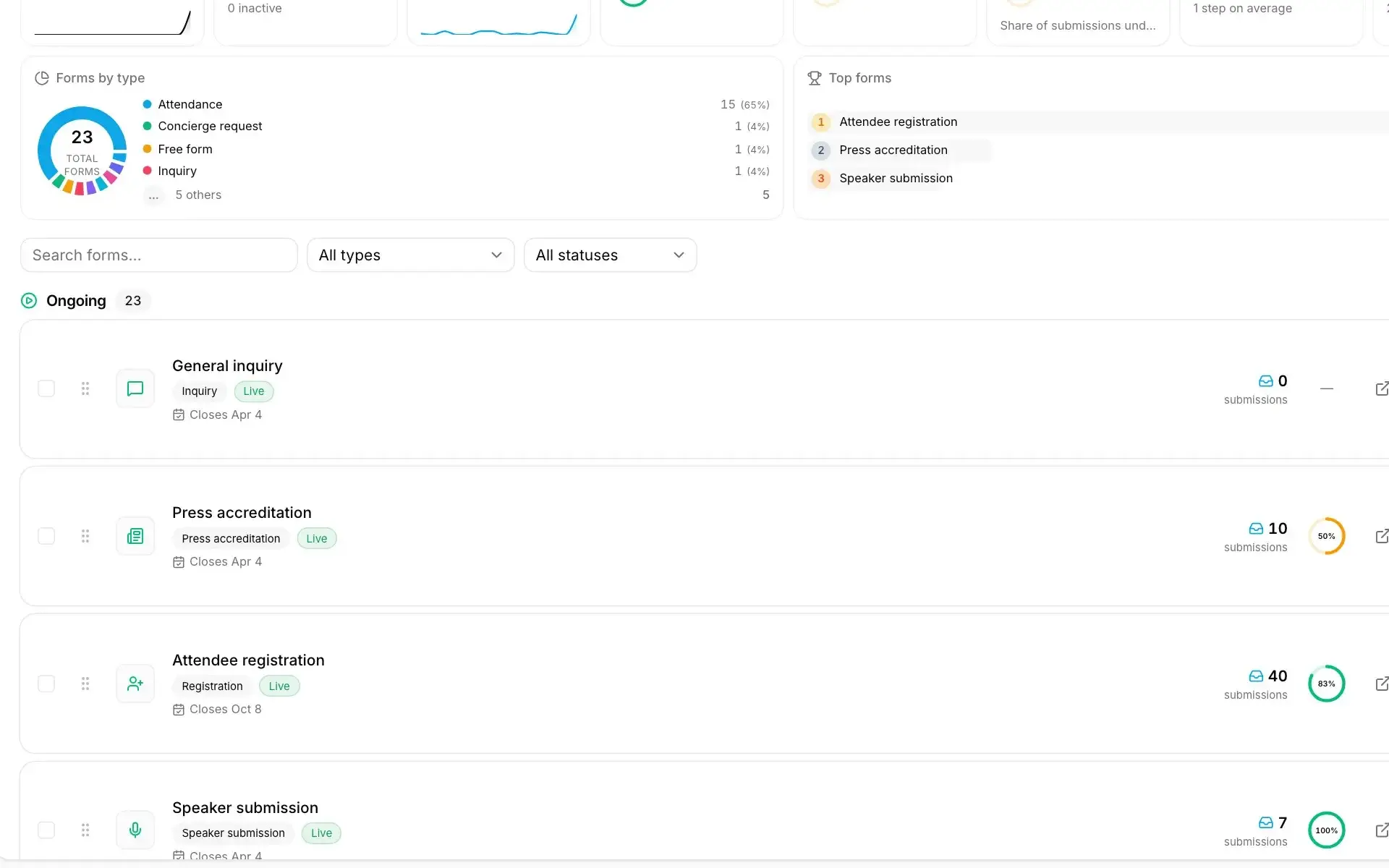
In Moultaka, the speaker submission form is built without a developer, with conditions, and you can see who completed it and who dropped off. It is open only within its dates and has its own link and QR code, on the event website alongside the other forms. Applications, profiles, sessions and ratings are kept for every speaker and panellist, and once the programme is built it is published to the website and the app as soon as you save. See conferences and engagement, and to see your next call for speakers run in it, book a demo.