Conference report template: how to write the post-conference report, with an example
A conference report template for organisers: the format section by section, a filled example, how to word recommendations and where each figure comes from.
By Moultaka team

A conference report is the document the organiser sends after the event to record what was said and what comes out of it: the theme, each session and its main points, the discussion, the recommendations and a few honest attendance figures. A good one runs to four to ten pages, is written from the notes of session rapporteurs, and goes out within two to three weeks to the host institution, the funders and partners, the speakers and the delegates. Below: how a conference report differs from the closing summary and the proceedings, who writes it, a conference report template section by section, a filled example you can adapt, and how to word recommendations that someone will actually act on.
Report, summary, recommendations, proceedings: four different documents
The words get used interchangeably, but they are four documents with different authors and deadlines.
| Document | Written by | For | When | Length |
|---|---|---|---|---|
| Closing summary | The general rapporteur | The audience in the room | Last day, at the closing session | Ten to fifteen minutes read aloud |
| Recommendations | The scientific committee and the general rapporteur, with the room | Named recipients: ministry, institution, industry body | Read at the close, circulated within a week | One numbered page |
| Conference report | The organising committee, from the rapporteurs’ notes | Host institution, funders, partners, delegates, sometimes the press | Two to three weeks after | Four to ten pages |
| Proceedings | The scientific committee and a publisher | Researchers and libraries | Six to twelve months after | The full papers |
The report absorbs the summary and the recommendations, and adds what they leave out: what actually happened on the day, who could not come and who replaced them, the attendance, and what the next edition will do differently.
This guide covers the organiser’s report. If you attended a conference and your employer or funder wants a report on what you learnt, the logic is different: that is a trip report, written from one person’s point of view.
Who writes a conference report
Nobody writes a usable report from memory. It is set up before the opening, by appointing note-takers.
- One rapporteur per session. A PhD student, an early-career researcher or a committee member in the front row, noting each paper’s main argument and the questions from the floor. Their note is due the same evening.
- A general rapporteur. Reads every session note, attends as many sessions as possible and drafts the summary read at the closing session. At academic conferences this is often a senior member of the scientific committee.
- The organising committee. Assembles the final report: summary, recommendations, programme as delivered, figures and photos.
Give every session rapporteur the same one-page form:
| Field | What the rapporteur writes |
|---|---|
| Session | Title, room, time, chair |
| Papers | For each: speaker, title, main argument in two or three sentences |
| Discussion | The three or four questions that drew the strongest response, and the answers |
| Key point | One sentence on what the session adds to the conference theme |
| Possible recommendations | Anything the speakers or the floor proposed doing |
With a shared form, the general rapporteur receives notes that compare, and the summary takes one evening instead of a week.
Conference report format, section by section
This conference report format works for a one-day symposium as well as a three-day international congress. Scale the session section to the size of your programme.
| Section | What goes in it | Common mistake |
|---|---|---|
| Cover page | Exact title, dates, venue, organiser, partners and funders | A title that differs from the poster |
| Overview | Theme, the question the conference asked, the tracks | Pasting the whole call for papers |
| Programme as delivered | Opening, sessions in order, closing, with last-minute changes | Copying the planned programme instead |
| Sessions | For each: the papers and their main points, then the discussion | Summarising well-known speakers and skipping the rest |
| Summary | What the conference established, what remains open | A list of thanks in place of a summary |
| Recommendations | Numbered, each with its recipient | Wishes no one can act on |
| Attendance | Registered, attended, speakers, countries and institutions, attendance per session | Reporting registrations as if everyone came |
| Evaluation | What delegates said in the post-event survey, what will change | Leaving it out, though it shapes the next edition |
| Appendices | Final programme, speaker list, photos, recommendations on a separate page | Appendices longer than the report |
Conference report example to adapt
Here is a conference report template filled in as an example for a two-day international conference. Replace the bracketed parts and delete what does not apply.
Report of the International Conference “[Title]” [Host institution], [city], [dates]
1. Overview Organised by [department, institute or association] with the support of [funders and partners], the conference brought together [number] delegates from [number] countries around one question: [the question, in one sentence]. The programme ran across [number] sessions in [number] tracks: [track 1], [track 2], [track 3].
2. Opening The conference was opened by [name, position], who stressed [main point of the welcome address]. [Name], chair of the scientific committee, set out the aims of the programme.
3. Sessions Session 1, “[title]”, chaired by [name]. [Speaker 1] argued that [main point]. [Speaker 2] presented [main point]. Discussion focused on [main questions]. Session 2, “[title]”, chaired by [name]. […]
4. Summary The general rapporteur, [name], drew three conclusions: [conclusion 1], [conclusion 2], [conclusion 3]. Open questions remain on [question 1] and [question 2].
5. Recommendations See the attached page.
6. Attendance [Number] registered; [number] attended on day one and [number] on day two; [number] papers presented out of [number] accepted; [number] speakers, of whom [number] travelled from abroad.
7. Next steps Proceedings will appear in [journal or publisher] in [month, year]; full papers are due by [date]. The next edition is planned for [period].
[Name], Chair of the Organising Committee, [date].
If the report goes to a funder with its own template, as research councils and development agencies often require, keep their headings and slot this content under them: the reviewer will look for their sections first.
How to write a conference report’s recommendations
The recommendations are what the host institution, funder or industry body usually reads first. Prepare them during the conference, not after it.
Four rules are enough:
- One recommendation, one action. “Set up a joint working group of the three regional laboratories on [topic]” rather than “strengthen cooperation”.
- A recipient for each. The ministry, the university, the professional association, industry, the organisers of the next edition.
- Five to ten at most. Beyond that, none get read.
- Read at the close before they circulate. The room adds to them or corrects them; the final text goes out within the week.
An example of the wording:
- Delegates recommend that training providers [specific action] from the [year] intake.
- They invite [organisation] to [specific action], and offer [contribution] to support it.
- They ask that the next edition give a full session to [topic], with speakers from industry.
The figures in the report, and where to get them
A report without figures reads like an impression; a report with wrong figures is noticed quickly. Take each number from where it was recorded, not from the team’s memory.
| Figure | Where it comes from |
|---|---|
| Registrations, by category (speakers, delegates, students, guests) | The registration list |
| Attendance, by day | The sign-in sheet or check-in record |
| Attendance per session | Badge scans at the room door, or a sign-in sheet per session |
| Papers presented, out of accepted | The final programme against your call for papers |
| Questions and polls | The Q&A and live polling tools used in the rooms |
| Satisfaction | The post-event survey sent after the close |
| Certificates issued | The certificates of attendance delivered |
Always separate registered from attended, and day one from the last day. The drop between them says a lot about the programme, and it is exactly what the committee will want to fix.
Sending the report, then preparing the proceedings
Send the report within two to three weeks, while people still remember the conference:
- to the host institution and the funders, in the format they ask for, with the recommendations on their own page;
- to partners and sponsors, with what concerns them: their presence, their visibility, the attendance;
- to speakers and session chairs, with a word of thanks;
- to delegates, with links to the slides where speakers agreed;
- to the press, as a short release built on the summary.
Put a short version on the conference website too. It keeps a record and helps the next call for papers.
The proceedings come later. State in the report where and when they will appear and the deadline for full papers: speakers who did not note it in the room will find it there.
Mistakes to avoid
- Appointing rapporteurs on the morning. Without a form, everyone notes differently and the summary becomes guesswork.
- Writing the summary a month later. The notes have gone cold, speakers have moved on and the recommendations lose their weight.
- Reporting the planned programme. A speaker who did not come, a session that moved: the report says what happened.
- Recommendations without a recipient. Nobody feels bound to act on them.
- Inflating attendance. Registrations are not attendance, and funders can count.
- Skipping the evaluation. What delegates found too long or too short is the first input to the next edition.
For the whole project, see our guide on how to organize a conference, or how to plan a workshop event for the one-day version. If your event is a trade show rather than a conference, the equivalent document is the post-show report.
A report that starts with the figures already in place
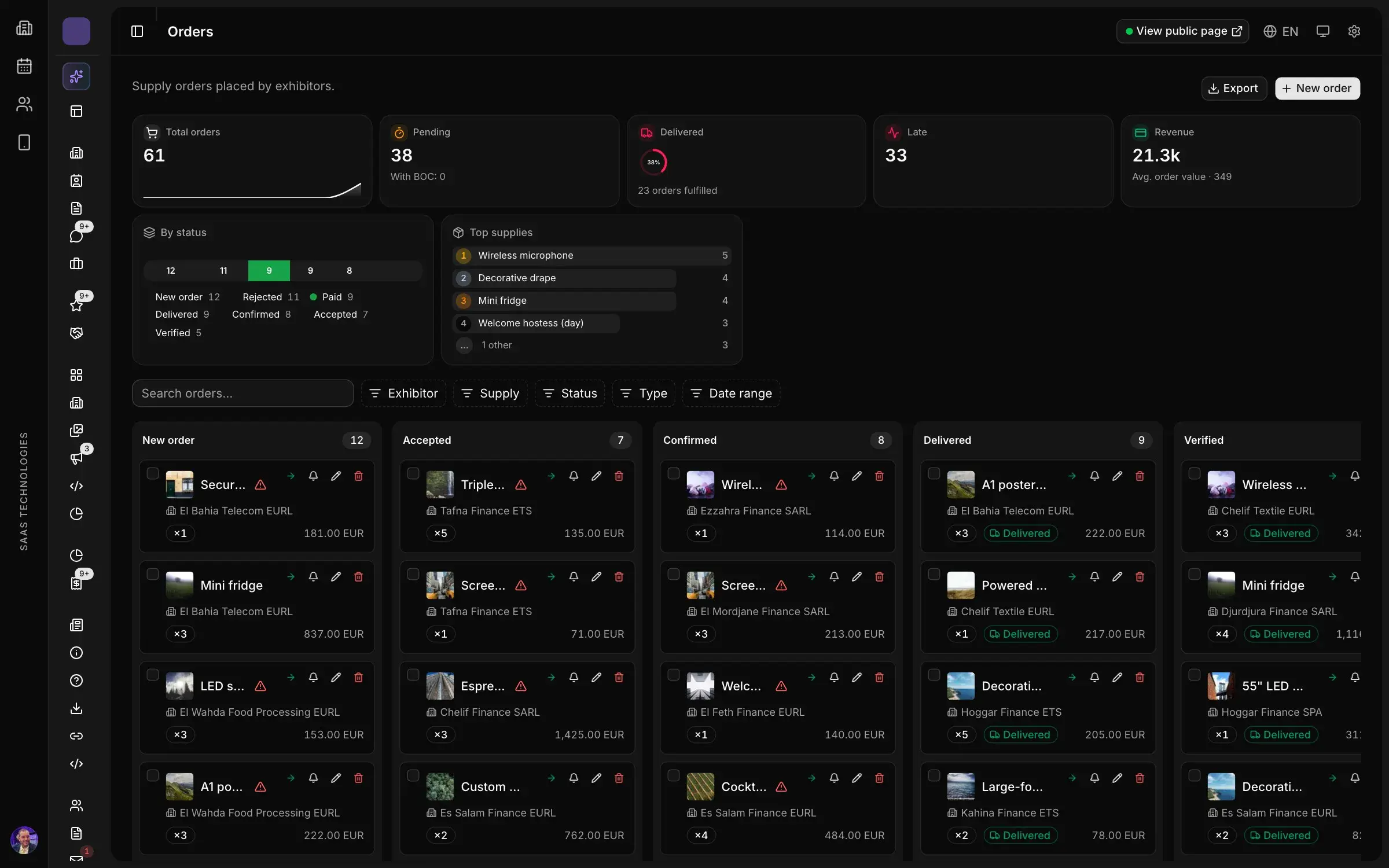
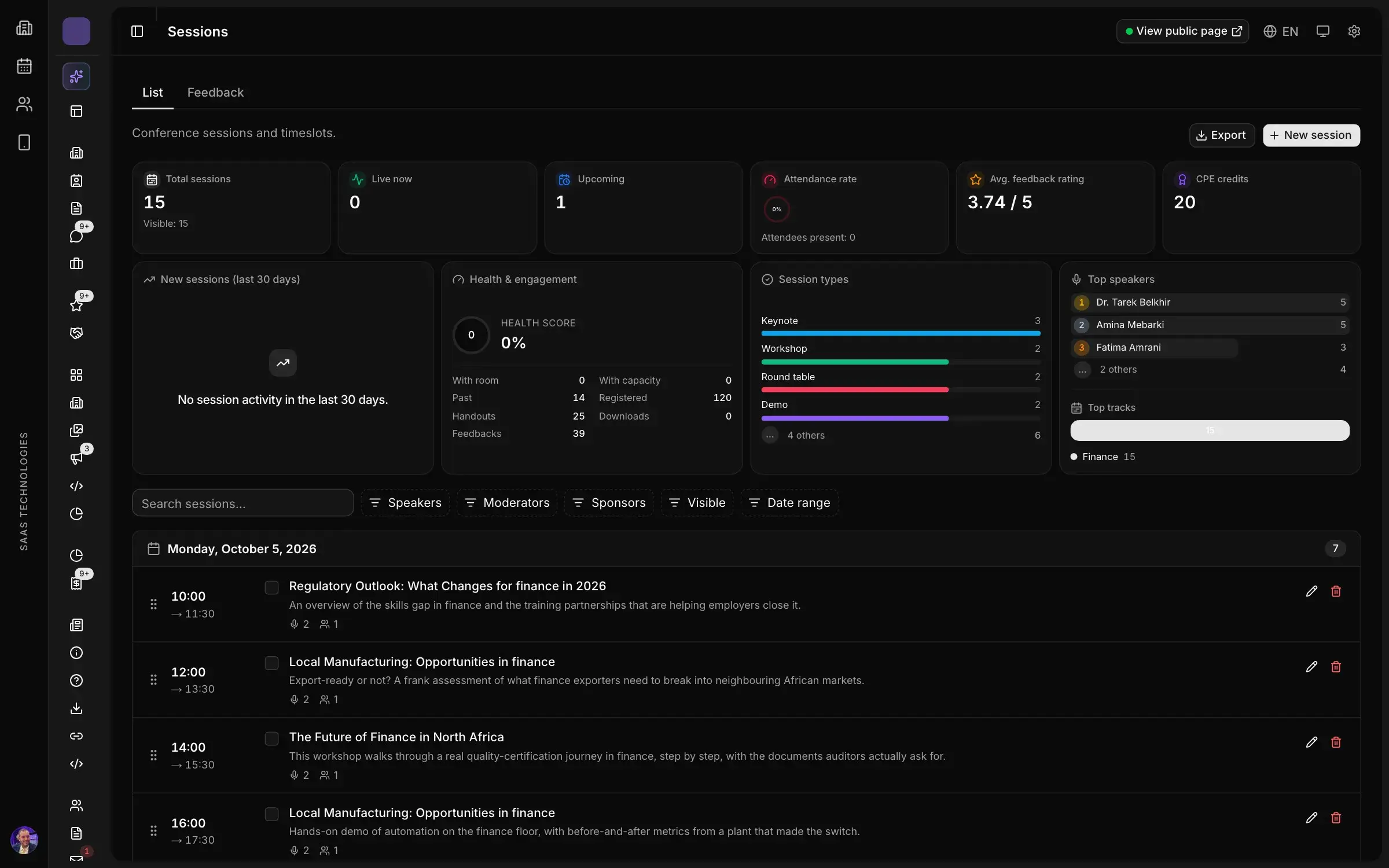
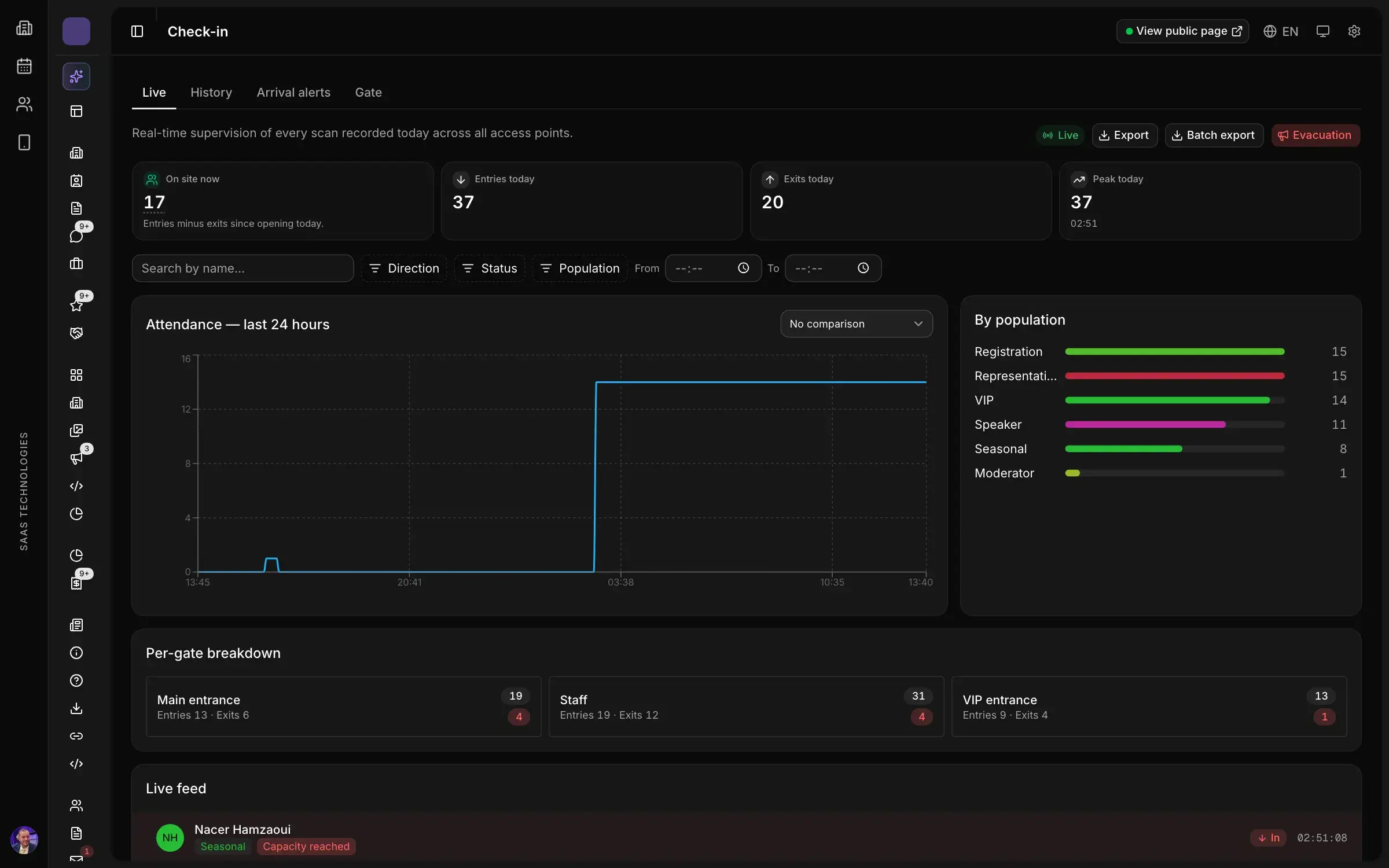
In Moultaka, the Conferences module plans sessions, speakers and moderators in one place; in the room, the audience asks questions, votes in live polls, and every session gets its feedback. Attendance per session, registrations and certificates of attendance are recorded as the conference runs, every list exports to a spreadsheet, and the AI assistant answers from your own data when you ask how many delegates attended each session. To see it on your next conference, book a demo.