How to organize a panel discussion, step by step
How to organize a panel discussion at a conference or trade show: the question, the panellists, a one-page brief, a 60-minute format and the follow-up.
By Moultaka team
To organize a panel discussion, start from a question rather than a topic: one that three or four panellists would answer differently. Then pick panellists whose views complement and challenge each other, a moderator who is not one of them, and send everyone the same one-page brief three weeks out. On the day, a panel runs 45 to 75 minutes: short opening answers, two or three prepared follow-ups, a block of audience questions and a closing round. Below are the steps in order, a panel brief you can copy, a minute-by-minute format and the mistakes that keep turning up, whether your panel sits on a trade show stage or in a conference programme.
Panel, keynote, fireside chat: pick the right format
Programmes use these words loosely. What sets them apart is who speaks, and for how long.
| Format | Who speaks | Typical length | Use it when |
|---|---|---|---|
| Keynote | One speaker, a few questions | 20 to 45 min | One voice has something the whole room needs to hear |
| Fireside chat | One guest, one interviewer | 30 to 45 min | A well-known guest, a personal story, a candid tone |
| Panel discussion | Three to five panellists, one moderator | 45 to 75 min | Several viewpoints on an open question |
| Round table | The same idea, seated, often longer and more formal | 60 to 90 min | Institutional or academic settings, policy questions |
On a trade show floor, panels are often the content that keeps visitors in the hall between appointments. At a conference, they break up a day of single-speaker sessions and give the audience a voice.
Step 1: write the question, not the topic
“The future of cold-chain logistics” is a topic: each panellist delivers a mini-keynote and nobody responds to anyone. “Should Gulf distributors build their own cold storage or rent it?” is a question: it forces a position, and it gives the moderator somewhere to steer back to.
A good panel question:
- fits in one line of the agenda;
- has at least two defensible answers;
- matters to the people in the room, not only to the people on stage;
- can be covered in an hour. If it needs a day, it is a workshop or study day.
Write the session title as it will appear in your conference agenda: short, with the question or its stakes in it.
Step 2: three or four panellists, plus a moderator
With five panellists and an hour, each one speaks for about eight minutes in total, and the audience drifts. Three or four is enough for views to collide and few enough for each to go deep.
Build the panel for balance:
- different seats at the table: an operator, a researcher or analyst, a regulator or investor, a customer or end user;
- never two people from the same company: they will say the same thing;
- one voice that disagrees: without it, the panel turns into a row of presentations;
- a mix of backgrounds and genders wherever the subject allows it. Audiences notice, and so do sponsors.
The moderator is not a fifth panellist. They prepare the questions, share out the floor, keep time and bring the audience in. Pick someone who knows the subject without having a stake in it: a trade journalist, an academic, a member of your programme committee. What they do on stage is covered in our guide on how to moderate a panel discussion.
Invite in writing, with the question, date, length and the names of the other panellists you have in mind. A clear speaker invitation letter gets a yes faster than a chat message.
Step 3: the panel brief, one page for everyone
Three weeks before the session, send every panellist and the moderator the same brief. It heads off most of the surprises on the day.
| Section | What goes in it |
|---|---|
| Title and question | The question as printed in the agenda, and what you hope the discussion achieves |
| Date, time, room | Plus the call time: 30 minutes before the start |
| Panellists | Name, title, organisation, and the angle you expect from each, in one line |
| Moderator | Name, contact details, and when they will call each panellist |
| Running order | The minute-by-minute format (see below) |
| Slides | None, or one slide per panellist at most |
| Audience | Who will be in the room, how many, what they already know |
| Audience questions | Roaming microphone, or questions sent from phones |
| After the session | Summary, photos, recording if any, what will be published |
A brief to copy:
Panel: Should Gulf distributors build their own cold storage or rent it? Tuesday 12 May, 11:00 to 12:00, Stage 2. Please arrive at 10:30 for a microphone check. Panellists: [name], operations director (angle: cost of owning); [name], analyst (angle: capacity and demand); [name], third-party logistics provider (angle: what renting still offers). Moderator: [name], [title], on [phone number]. No slides. Opening: two minutes each on your answer to the question. Then discussion; audience questions from 11:35. After the session: we will send you the summary before it is published.
Step 4: a minute-by-minute format
Without a written running order, the audience questions are always the part that gets cut. Here is a 60-minute format to adapt:
| Minutes | Segment | Who |
|---|---|---|
| 0 to 3 | Welcome, the question, quick introductions | Moderator |
| 3 to 12 | Opening round: two minutes each on their answer | Panellists |
| 12 to 35 | Discussion: three prepared follow-ups, one per disagreement | Moderator, panellists |
| 35 to 38 | A live poll on the question, results on screen | Moderator |
| 38 to 55 | Audience questions | Audience, panellists |
| 55 to 60 | One closing sentence each, thanks | Moderator |
On a busy show floor stage, cut it to 40 minutes: a six-minute opening round, fifteen minutes of discussion, fifteen of questions, four to close. Put the timings in your run of show, with the name of the person who signals the five-minute mark to the moderator.
Step 5: room and stage
The layout shapes the conversation:
- armchairs or high stools rather than a table where you can: panellists see and answer each other; a table with name cards suits formal round tables;
- one microphone per panellist, one for the moderator and one or two for the audience;
- a screen showing the title and the panellists’ names, then the audience questions and poll results;
- a timer the moderator can see;
- water for everyone on stage, and reserved front-row seats for VIP guests if your protocol calls for them.
If the panel runs in two languages, say so in the agenda and book interpreters, or ask panellists to restate their key point in the other language.
Step 6: fill the room, then involve it
A panel needs a full room. Publish it in the agenda with the question as its title and the panellists’ names, open session sign-ups if the room is small, and promote it a week ahead and again the day before.
On the day, plan for participation:
- questions from phones: the audience sends them during the discussion, anonymously if they prefer, and the moderator picks the strongest instead of handing the microphone to the first raised hand;
- a poll halfway through: it wakes the room and gives panellists something to react to;
- questions submitted before the session, for those who would never raise a hand.
After the panel
The work is not over when the room empties:
- thank the panellists in writing the same day;
- write the summary: each position, where the panel agreed, what stayed open, following the outline of a conference report;
- issue certificates to speakers and attendees who need them, from a certificate of attendance template;
- read the session ratings, and keep what will help you choose next year’s question.
Mistakes that keep turning up
- A topic instead of a question: nobody disagrees, the room switches off.
- Six panellists so as not to offend anyone: each speaks for eight minutes, the audience asks nothing.
- Slide decks: the panel becomes a string of short keynotes.
- The moderator is also a panellist: they can neither push back nor cut in.
- No written running order: the audience questions get dropped.
- Nothing left afterwards: the panellists’ work disappears with the session.
Running panels with Moultaka
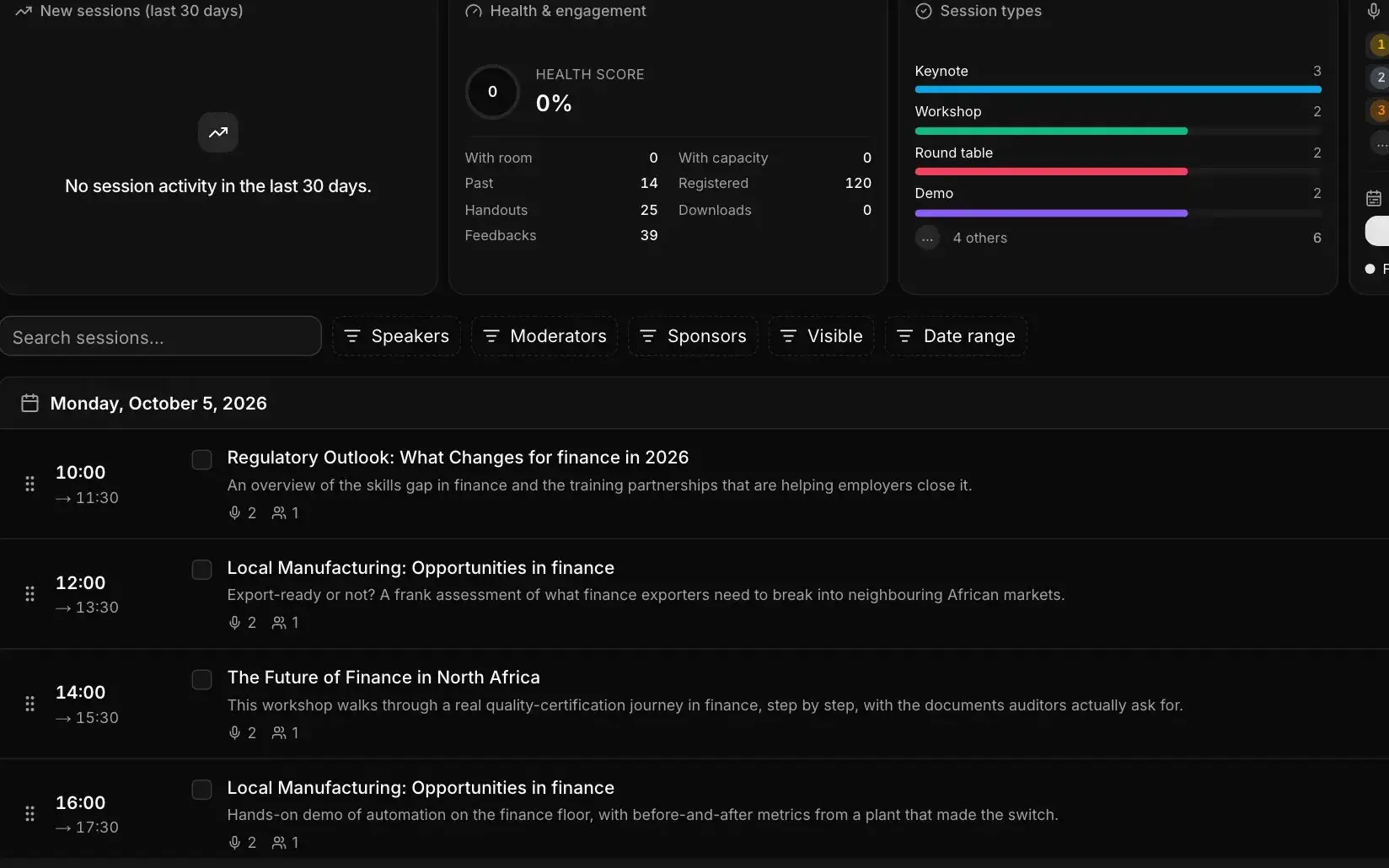
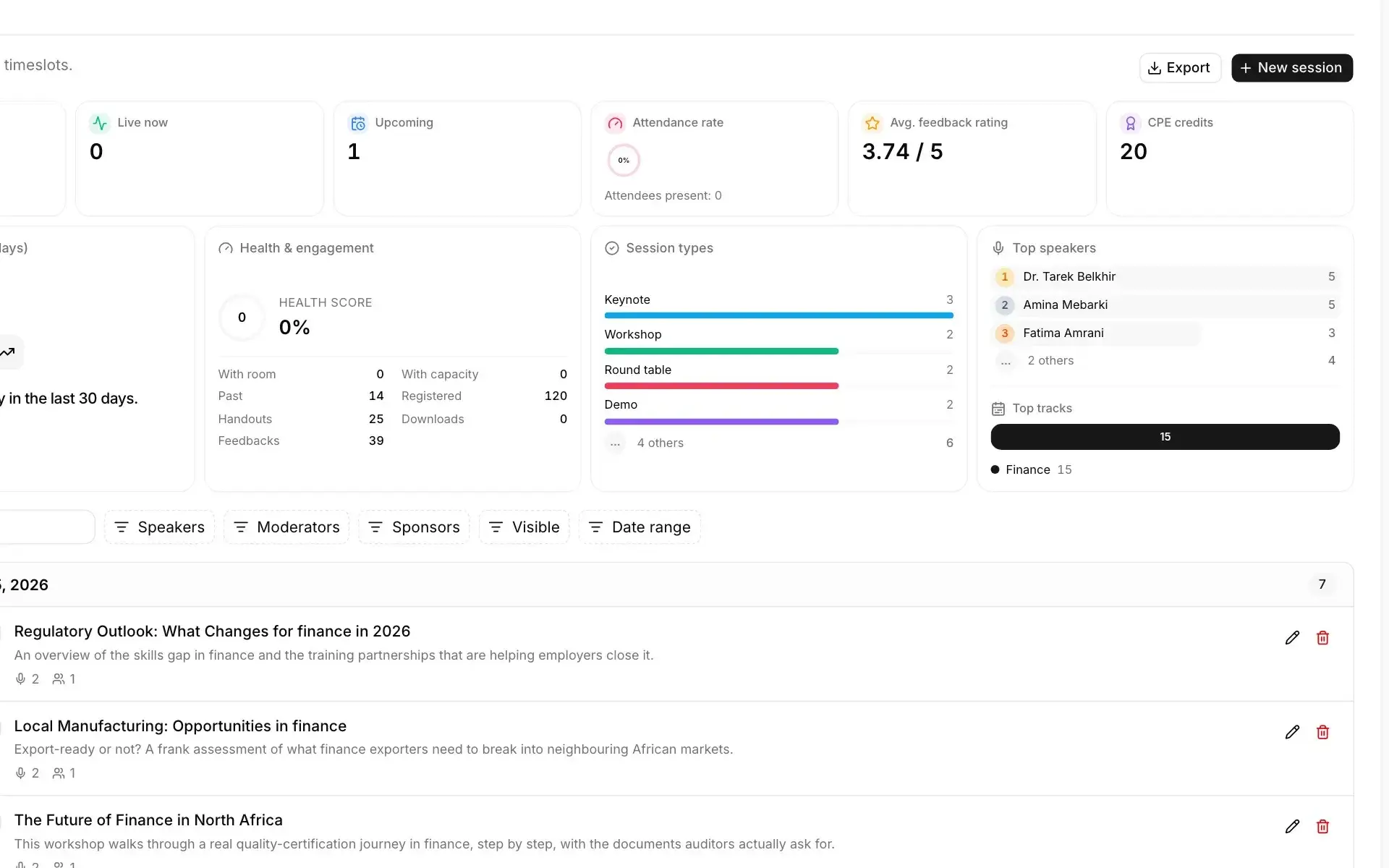
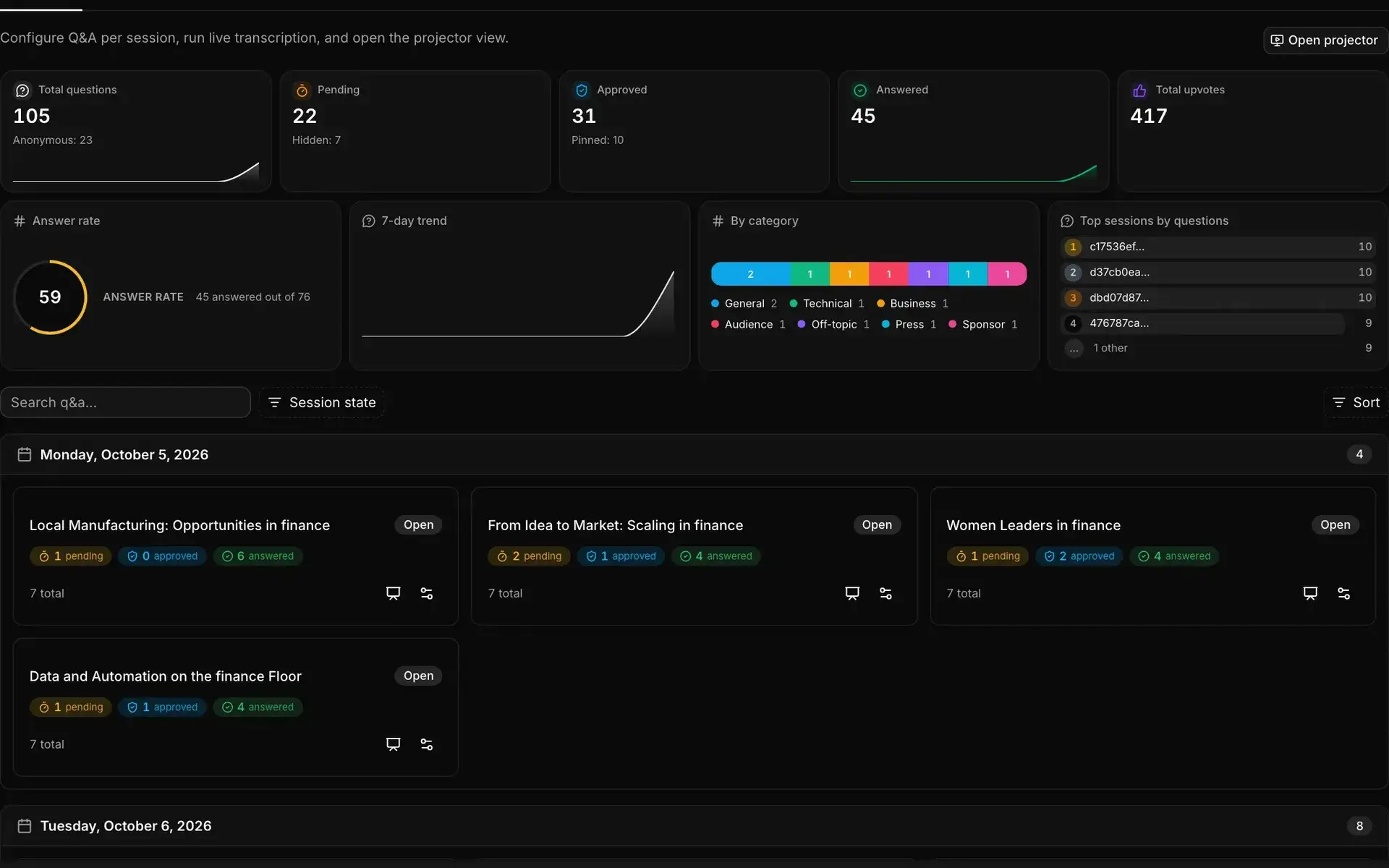
In conference management software such as Moultaka, a panel is a session in the programme: its speakers, moderator, room and format are planned in one place, and the programme is published to the website and the app as soon as you save. Moderators see their sessions, their instructions and the questions waiting for them. In the room, the audience asks from their phone, anonymously if they wish; moderators approve, pin and mark questions answered, and the speaker reads them on screen. Polls prepared in advance are started during the session, with results projected on the room screen as votes come in. Afterwards, every session gets its ratings and comments, and you know who attended it.
To see how a panel is prepared and run in Moultaka, book a demo.