Certificate of attendance for a conference or seminar: a template, the wording and when to send it
A certificate of attendance template for conferences and seminars: attendance, participation or presentation, the wording, the signatory and delivery.
By Moultaka team
A certificate of attendance for a conference states, on one signed page, that a named person attended a named event, on given dates and at a given venue, and in what capacity: delegate, speaker, session chair, committee member. It carries the issuing organisation, the exact title of the event, the participant’s name as it appears on their ID, their capacity, the title of their presentation if they gave one, the number of hours or days where it matters, the date of issue, the name, role and signature of the person responsible, and a reference number. It goes only to people who were actually there. Below: the three kinds of certificate, the wording to include, a certificate of attendance template you can copy, the variants for seminars and speakers, and how to send them without losing a week to it.
Attendance, participation or presentation: which certificate to issue
The three words are often used interchangeably. They do not certify the same thing, and participants use them for different files.
| Certificate | What it certifies | Who gets it | What it is used for |
|---|---|---|---|
| Attendance | The person was there on a given day, half-day or session | Every participant who attended | Proof for an employer, a training record, an expense claim, continuing education |
| Participation | The person took part, with their capacity: delegate, committee member, workshop facilitator | Delegates, committees, volunteers | A CV, an annual review, an application |
| Presentation | The person presented a paper or a poster, whose title is given | Speakers and accepted authors | An academic file, a funding report |
A scientific conference often issues all three: attendance for everyone present, and a presentation certificate for those who presented, with the title accepted by the programme committee. A training seminar issues mostly the first, because that is what the participant hands to their employer. A trade show rarely issues any, except for the conference sessions or training workshops on its programme.
Decide before the event. The type of certificate sets how attendance must be counted (per day, per half-day or per session) and what the registration form must ask.
What a conference certificate of attendance must say
| Field | Example | The common mistake |
|---|---|---|
| Issuing organisation | The university department, association or company running the event, with its address | Only the event logo, with no legal entity behind it |
| Exact event title | “5th International Conference on …” | A shortened title that does not match the programme |
| Dates and venue | “12–13 March, … Convention Centre, Dubai” | The year left out |
| Participant’s name | As on their passport or ID, with accents and the right order of names | A name copied from an illegible sign-in sheet |
| Role and organisation | “Senior Engineer, …” | Nothing, though that is what an employer checks |
| Capacity | Delegate, speaker, session chair, programme committee member | “Took part” with nothing more |
| Presentation title | The accepted title, in quotation marks, and its format: oral or poster | The title from the submission, changed since |
| Duration | “two days”, or a number of hours for a training course | Hours that do not match the published programme |
| Date and place of issue | “Issued in …, on …” | A date before the last day of the event |
| Signatory | Name, role and signature of the conference chair or head of the organisation | A signature with no printed name or role |
| Reference number | One unique number per certificate | No way to find or verify a certificate later |
If your event grants continuing professional development credits (CPD, CME), the body that accredits the credits sets its own rules for the certificate: the wording, the number of credits, sometimes a session-by-session record. Read them before you design the certificate, not after.
Certificate of attendance template
[Organisation name] [Address] · [City, country]
CERTIFICATE OF ATTENDANCE No. [reference]
This is to certify that
[Participant’s full name] [Role], [organisation]
attended the [exact event title], organised by [organisation] on [dates] at [venue], [city], as a [delegate / speaker / session chair / programme committee member], for a total of [number] hours.
[For a speaker:] They presented [an oral presentation / a poster] entitled “[accepted title]” in the session “[session title]”.
Issued in [city] on [date].
[Signatory’s full name] [Role] [Signature]
Keep the sentence short and factual. “This is to certify that” is the form most employers and universities expect; flourishes about “outstanding contribution” belong in a thank-you note, not on a certificate someone will file. If your audience is international, offer the certificate in English and in the language of the host country, or let the participant choose.
Variants: training seminar, speaker, committee, trade show
Training seminar. Replace “attended the conference” with “completed the training seminar entitled …”, give the number of hours and, if employers ask for it, the programme on the back. It goes to the participant’s employer, so get the role and company right. To plan the seminar itself, see our guide on how to organize a seminar.
Presentation certificate. It quotes the final title, the format (oral, poster), the session and, for a conference with proceedings, whether the paper will appear in them if that has been decided. Take the title from the final programme, not from the call for papers: titles change between the two. Invited keynote speakers get the same certificate; how to invite them is in our speaker invitation letter template.
Committees and session chairs. A certificate of their own, naming the role: programme committee member, organising committee member, chair of a given session. They need it as much as the speakers do, and they are the ones most often forgotten.
Trade show. Visitors do not ask for certificates. Delegates of the show’s conference or training sessions do: treat those sessions like a seminar, with attendance counted at the door of the room.
Only certify those who attended
This is the rule that keeps a certificate worth something, and the one most often broken. Certificates produced from the registration list go to people who never came, and miss those who registered on site. A participant who receives a certificate for a day they skipped knows it; so may their employer or the accrediting body.
Count attendance at the level the certificate requires:
- per day, if the certificate only says “attended the conference”;
- per half-day, for training that states a number of hours;
- per session, if the certificate names sessions or the CPD body asks for it.
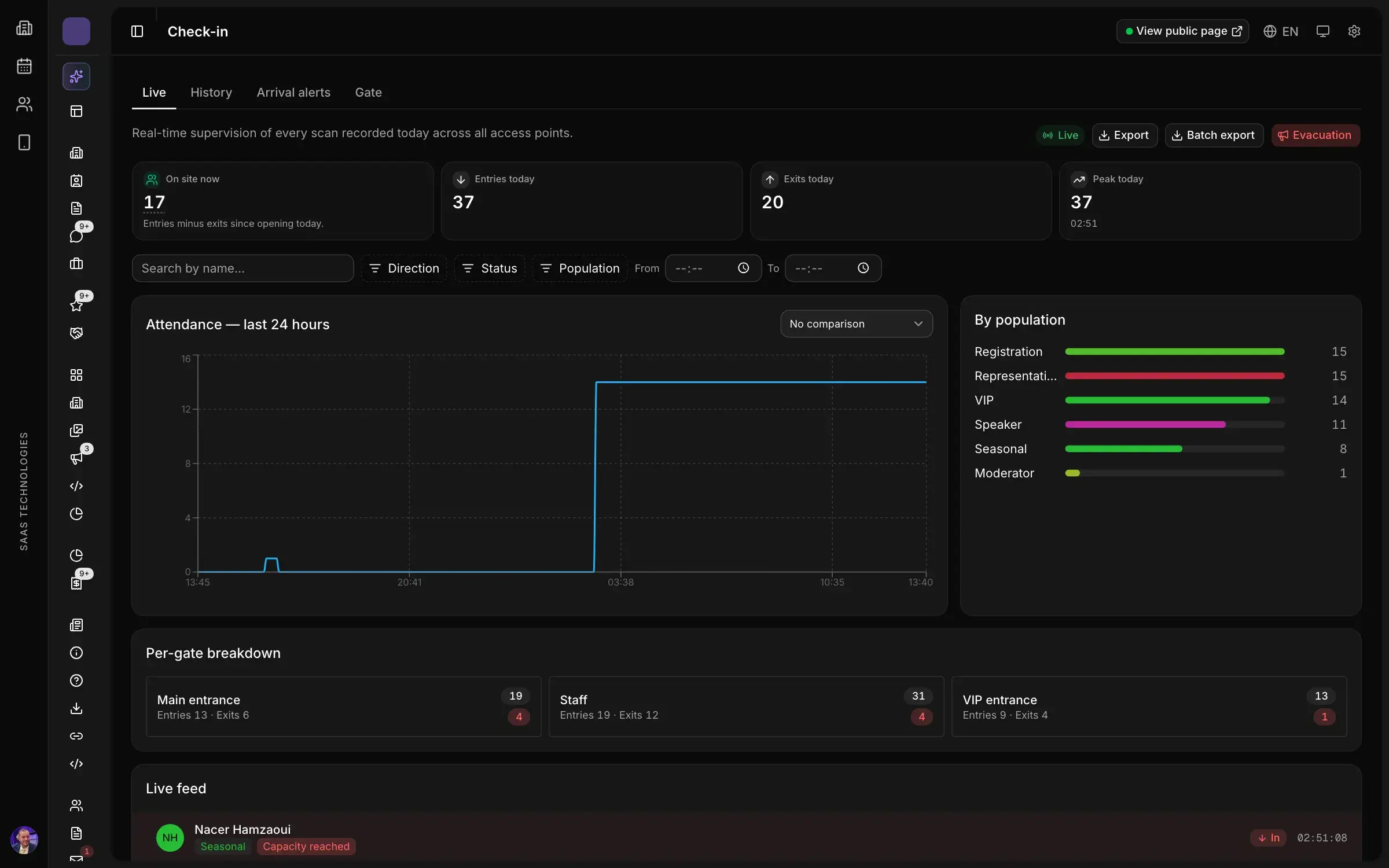
If you count on paper, our event sign-in sheet template gives the columns you need. If participants wear a badge with a QR code, a scan at the entrance and at the door of each room does the same job, with no retyping. Either way, the certificate starts from attendance, never from the registration list.
The name on the certificate comes from the registration form. Ask there for the name exactly as it should appear on official documents; that is where corrections are cheapest. If you hold personal data for certificates, the usual rules apply (GDPR in Europe, the local data protection law elsewhere): ask only for what the certificate needs.
When and how to send certificates
| When | Advantage | Drawback |
|---|---|---|
| At the exit, on the last day | Participants leave with it | It must be printed before you know who stayed to the end |
| By link, within days | Attendance is complete, corrections are easy | It must go out fast: after a week, the reminders start |
| On request | Nothing to prepare | Months of emails and certificates made one by one |
Sending by link within the week is the best balance. It can go out with the thank-you email or right after it, alongside the post-event survey. A named PDF with its reference number can be forwarded and printed without losing anything.
Keep the list of certificates issued, with their number and the attendance behind each one. An employer or a university that calls two years later to check a certificate should get an answer in a minute.
Mistakes that send a certificate back
- A misspelled name. Copied from a sheet or typed in capitals without accents, it comes back for correction.
- A shortened event title. It no longer matches the programme, and a reviewer comparing the two stops there.
- The submission title instead of the final one. The certificate must quote the title that was presented.
- Certificates for no-shows. Produced from the registration list, they undermine every other certificate you issue.
- No named signatory. A scanned signature with no name or role carries little weight.
- No reference number. Impossible to find, resend or verify a certificate.
- Sent a month later. Participants chase, the team answers one by one, and certificates go out in no particular order.
In short
- Decide before the event which certificates to issue: attendance, participation, presentation, or all three.
- Each states the organisation, the exact title, dates and venue, the participant’s name and capacity, the presentation title, the signatory and a reference number.
- It goes only to those who attended, counted at the level it requires, with the name taken from registration.
- Send it by link within the week, and keep the list of what was issued.
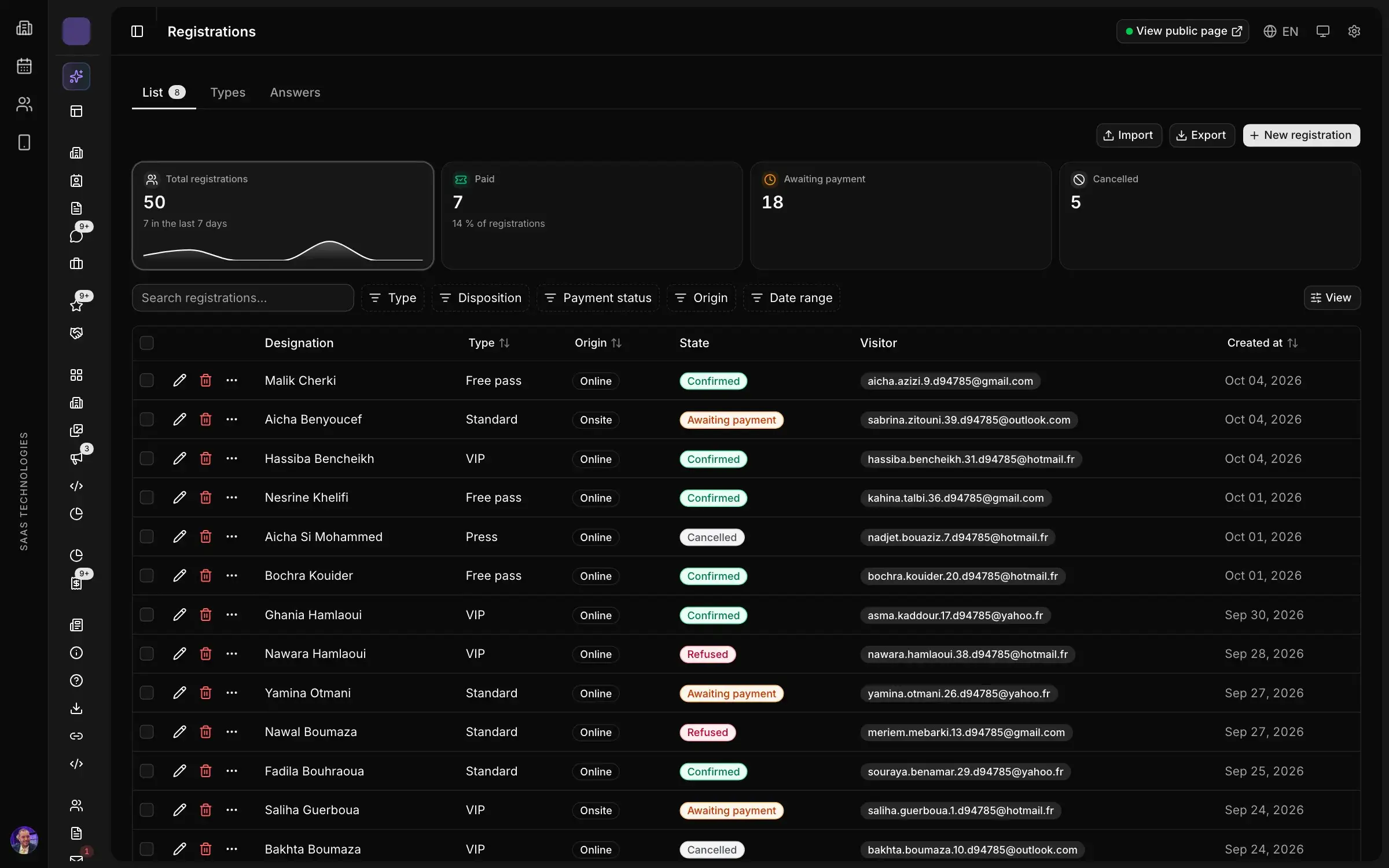
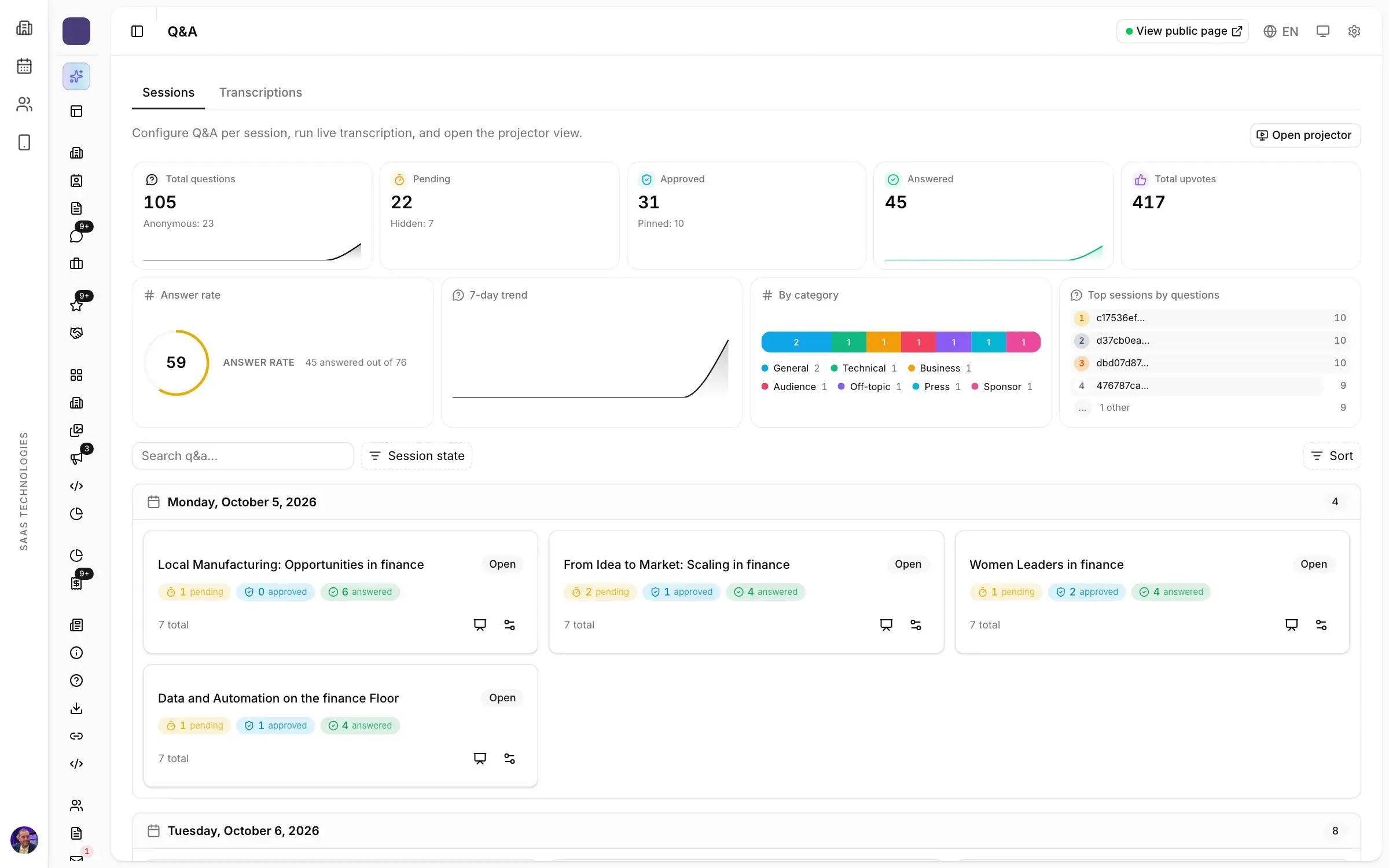
In Moultaka, the Badges, kiosks and access module issues certificates of attendance: one certificate per participant, generated from their attendance, signed by you and shared by link. The signatory, signature and artwork are set once; every certificate follows. Attendance is read at the entrance when the badge is scanned, and per session in Conferences and engagement, and the name comes from each participant’s single record in Registration and visitors. For the rest of the preparation, from the programme committee to the agenda, see our guide on how to organize a conference, and to see your next certificates start from real attendance, book a demo.