Exhibitor management: from the registration file to a finished stand
Incomplete files, wrong fascia boards, unapproved stand builders: how to centralise exhibitor preparation so the show is ready on time.
By Moultaka team
A signed exhibitor is not yet a ready exhibitor. Between signing the contract and the doors opening, they have to send their logo, their description, their fascia text, their staff list, their furniture and power orders, and their stand builder’s details. Multiply that by dozens or hundreds of companies, and exhibitor preparation becomes the heaviest workload of the show.
The real cost of scattered preparation
In many organisations, this information arrives through every channel at once: emails, phone calls, WhatsApp messages, spreadsheets sent back and forth. The result is familiar:
- incomplete files discovered the day before the catalogue goes to print;
- a fascia board printed with a typo, or in the wrong format;
- a stand builder who turns up for build-up without insurance or authorisation;
- staff badges requested on opening morning.
Each of these incidents costs time, money and a little of the exhibitor’s trust. They share one cause: nobody sees, in one place, what is still missing.
A portal for every exhibiting company
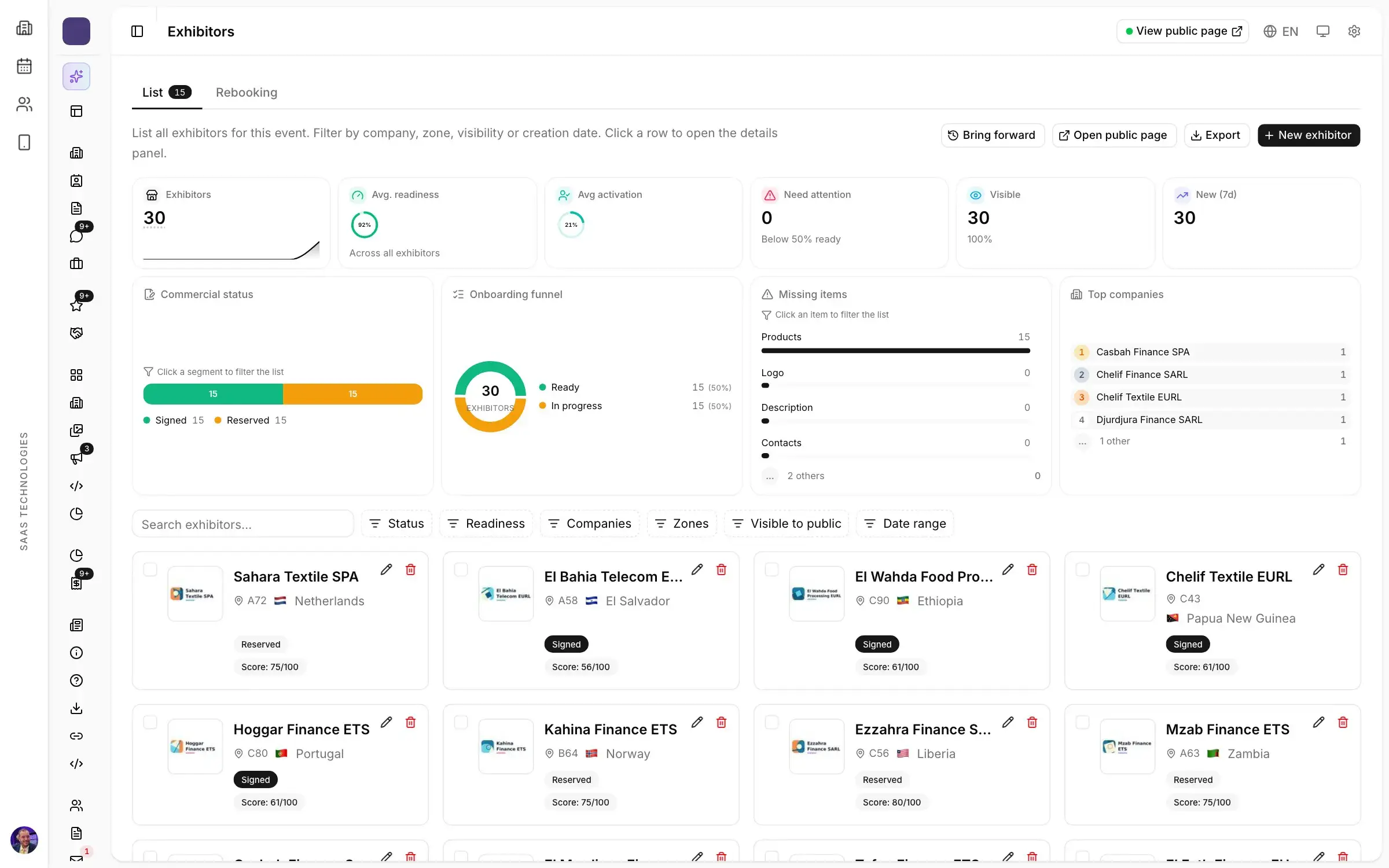
The fix is to reverse the logic: instead of chasing information, give each exhibitor a space where they fill in their own file. Company profile, logo, products on show, staff to accredit, orders: everything is entered once, by the person who knows the answer.
On the organiser’s side, each file shows how ready it is. You know which exhibitors are ready, which are late, and exactly what each one is missing. Reminders become targeted instead of generic.
That is the principle of the Exhibitors and operations product.
A clear catalogue of services
Furniture, lighting, screens, power connections, cleaning: present your services in an illustrated catalogue, with prices and conditions. Exhibitors order online, your operations team receives complete orders, and the catalogue carries over from one edition to the next instead of being rebuilt every year.
Fascia boards defined once
Signage errors are among the most visible: a truncated or misspelt name stays on display for the whole show. Define your fascia formats once and for all (board dimensions, background, character limits), and let exhibitors type their text within that frame. Nothing reaches the printer that does not fit the format.
Stand builders approved before build-up
Stand builders work on your site, under your safety rules. Require their insurance certificate and build-up authorisation before they arrive, and assign them build-up and breakdown slots. On the day, the team at the delivery gate knows who is expected and who is not.
Foreign exhibitors: plan for visas
For an international show, foreign exhibitors often need an invitation letter for their visa application. Handle these requests early, step by step, checking passport validity dates: a consular delay you did not plan for means an empty stand.
During the show: incidents tracked
A socket that does not work, a damaged wall panel, a lost parcel: small incidents are inevitable. What matters is that they are logged, assigned to someone and followed through to resolution, with an escalation rule when a deadline is missed. An exhibitor whose problem is solved within the hour leaves happy; one who waits all day will remember it when it is time to sign for the next edition.
Start the rebooking now
A well-supported exhibitor is the easiest one to bring back. Once the show is over, offer to renew their participation while the experience is still fresh, and rely on sales tracking linked to the floor plan to prepare the next edition.