Sponsorship request letter for an event
A sponsorship request letter for an event, a trade show or a conference: who to send it to, when, a six-part outline, a template and an email version.
By Moultaka team
A sponsorship request letter for an event fits on one page. It goes to a named person, says in two sentences what the show or conference is and who it brings together, offers one or two specific packages instead of an open request for money, points to the attached prospectus and ends with a date for a call. The full list of packages and benefits belongs in the sponsorship prospectus, not in the letter; how to build packages you can actually deliver is covered in trade show sponsorship fulfilment. Below: who to write to and when, the letter in six parts, a sponsorship request letter template to adapt, the email version, and how it differs from a donation request or a request for endorsement.
Letter, prospectus, agreement: three documents, three jobs
The letter gets you a meeting, the prospectus gives the sponsor what they need to decide, and the agreement records the deal. A letter that tries to do all three runs to four pages and nobody finishes it.
| Document | Its job | Length |
|---|---|---|
| Sponsorship request letter or email | Get a reply or a meeting | One page, or ten lines by email |
| Sponsorship prospectus | Present the audience, the packages, the benefits | Eight to fifteen pages |
| Sponsorship agreement | Fix the package, the fee, the deadlines, the proof | Whatever legal asks for |
Who to send it to, and when
“To whom it may concern” goes in the bin. Find the name of the person who owns the budget: the marketing, brand or partnerships manager, and in a large group the regional or country manager when your show takes place far from head office. LinkedIn and the company’s press releases usually give you the name in minutes.
Timing matters as much as wording. Many companies set next year’s marketing budget in the autumn. A request that lands in February for a show in May is asking for money that has already been allocated.
| When | What goes out |
|---|---|
| Six to nine months before | The letter or email to each target sponsor, with the prospectus |
| Ten days after sending | A short follow-up, ideally a phone call |
| Four to six months before | Meetings, then the signed agreement |
| Three months before | The sponsor’s assets: logo, copy, guest list |
Put these dates in your trade show planning timeline and the expected income in your trade show budget template, line by line.
The six parts of a sponsorship request letter
1. Subject line. “Sponsorship opportunity: [event name], [dates], [city]”. The reader should know what this is before opening anything.
2. The hook. One sentence about what the event does for their business, not about what you need. A medical device maker reads “600 hospital doctors and pharmacists over two days” closely; they skim “we are looking for partners”.
3. The event in three facts. Edition, dates, venue, and the expected audience by profile. Last edition’s figures if there was one; if not, the audience you are targeting and how you will bring it in.
4. The offer. One or two named packages with two or three benefits each, chosen for this sponsor. The full menu is in the prospectus.
5. Proof you will deliver. One sentence about the report they will receive after the event: benefits delivered, leads, measured visibility. For a marketing manager who will have to justify the spend, this is often what tips the decision.
6. Next step. A precise date: “I will call you on [date] to arrange a meeting.” Then your name and a direct line.
Sponsorship request letter template for an event
Subject: Sponsorship opportunity: [event name], [dates], [city]
Dear [name],
From [date] to [date], [event name] will bring together [number and profile of attendees: buyers, healthcare professionals, industry decision-makers…] at [venue] around [theme of the edition].
This is exactly the audience [company] works with, which is why we would like to invite you to join us as a sponsor.
Two packages seem a good fit for your goals:
- [Package 1]: [benefit 1], [benefit 2], [benefit 3];
- [Package 2]: [benefit 1], [benefit 2].
After the event, you will receive a report on every benefit delivered, with proof and the visibility figures for your brand.
Our sponsorship prospectus is attached, with the programme, the expected audience and the full range of packages.
I will call you on [date] to find a time that suits you.
Kind regards,
[Full name], [title], [organisation], [direct phone], [email]
For an academic or medical conference, swap the buyers for the researchers, clinicians and students you expect, and the packages for what matters to a lab or a publisher: a sponsored session, a booth in the exhibition area, the logo on the programme and the certificates. The rest of the work is in how to organize a conference.
The shorter email version
Most first contacts now happen by email, with the signed letter following alongside the prospectus. Keep it to ten lines:
Subject: [event name]: a sponsorship idea for [company]
Hi [first name],
[Event name] brings [audience] to [city] on [date].
We would like to offer [company] our [package name] package, which includes [lead benefit] and [second benefit].
The full prospectus is attached. Would you have 20 minutes in the week of [date] to talk it through?
[Signature]
One email per company, never a list in CC. The same rules apply as for a trade show invitation email: a subject line that says it all, one link or one attachment.
Sponsorship, donation, endorsement: three different requests
| Request | Sent to | What you offer in return |
|---|---|---|
| Sponsorship | A company | Visibility and access to an audience, priced in a package |
| Donation or grant | A company, foundation or fund | Support for a cause, with no commercial return to match |
| Endorsement or patronage | A ministry, trade body, chamber or royal court | Their name on the event, and often their presence at the opening |
An endorsement is never requested with a package. The letter presents the event and its value to the sector, and asks for the body’s support and for a representative at the opening ceremony. In the Gulf, an event held “under the patronage of” a ruler or minister follows its own protocol and lead time; the day itself is covered in VIP protocol for official delegations.
After you send it
- Follow up after ten days, by phone. “I wanted to check the prospectus reached you” opens more meetings than a second email.
- Log every exchange with the next action and its date. A sponsorship campaign soon covers thirty companies, and the meetings stretch over months.
- Write the agreement from the package, benefit by benefit, each with its place, its date and the proof you will provide.
- Start the report the day it is signed. It is built during the show, not after. It is one part of your post-show report, and it opens next year’s renewal.
Mistakes that get the letter ignored
- Asking for an amount with no package and no benefits.
- The same letter to thirty companies, addressed to nobody in particular.
- Three paragraphs of organiser history before a word about the audience.
- Attendance figures you will not be able to prove in the report.
- No follow-up date, or one that never happens.
Tracking your sponsorship requests
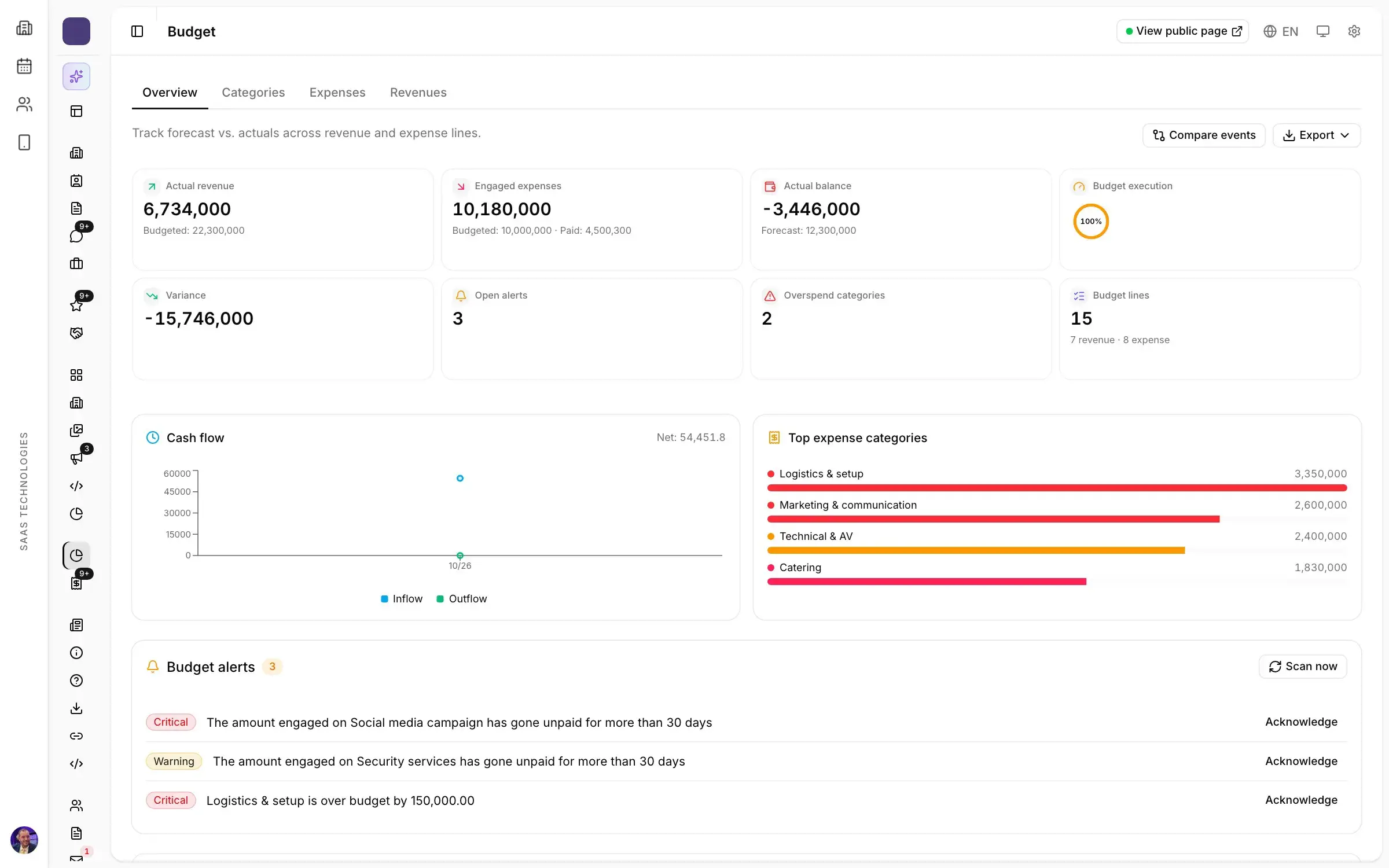
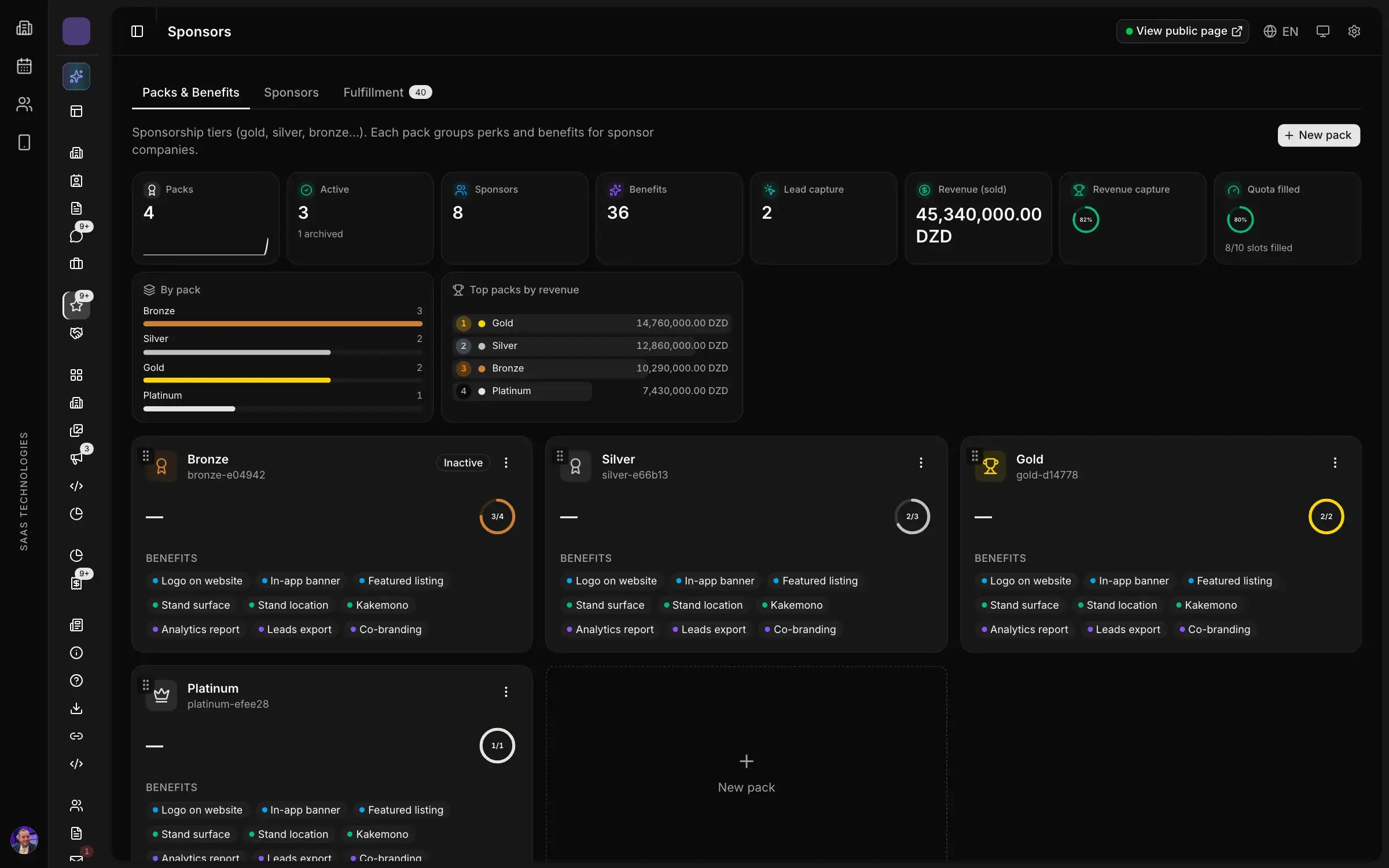
In Moultaka, each target sponsor becomes a deal you move stage by stage, with amounts and the weighted total following. Shared templates for quotes, sponsorship offers and follow-ups are filled with the deal’s details, and rules create a follow-up task when a deal stalls. Once signed, each package lists its benefits, its price and its quota, and every benefit promised becomes a card tracked to delivery. See Stand sales & CRM and Sponsors & advertising; to see it on your own show, book a demo.